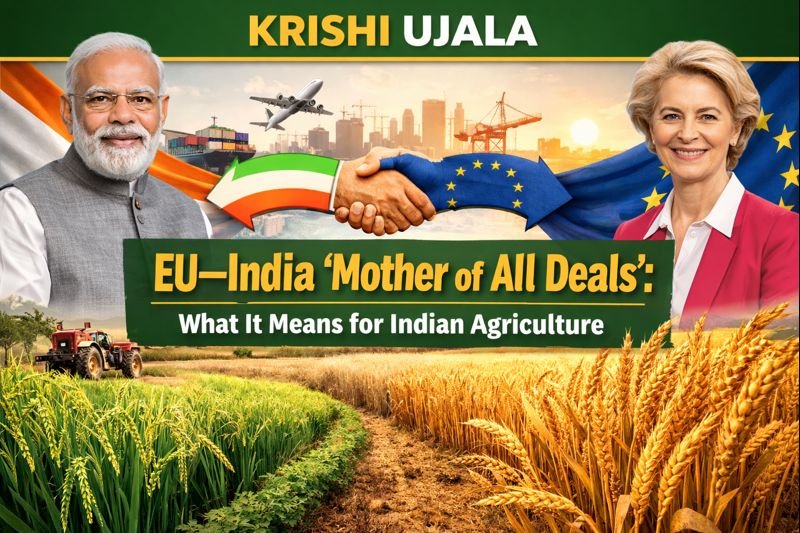
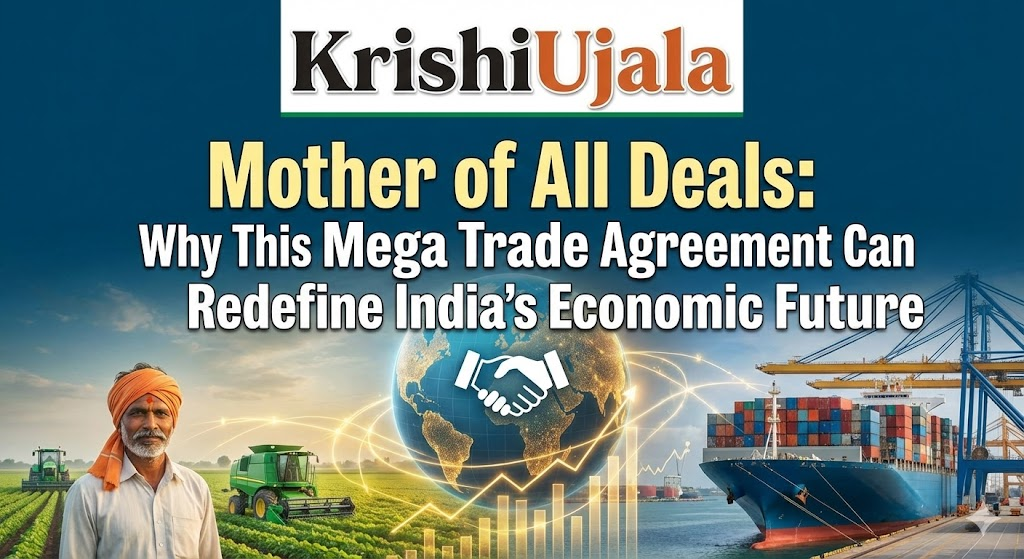
The recently concluded EU–India Free Trade Agreement (FTA)—widely described as the “Mother of All Deals”—marks a historic milestone in global trade relations. After nearly two decades of negotiations, India and the European Union have reached a comprehensive agreement that promises to reshape economic cooperation between two of the world’s largest economies. Covering a market of nearly 2 billion people, the deal is expected to significantly influence trade flows, investments, and sectoral growth, including agriculture, one of the most sensitive and vital areas for India.
Why This Deal Matters
The EU–India FTA “Mother of All Deals ” is significant not only because of its scale but also due to its strategic timing. In an era of global trade uncertainty, protectionism, and shifting supply chains, the agreement signals a renewed commitment to rules-based, multilateral trade.
Key highlights of the deal include:
- Reduction or elimination of tariffs on a majority of traded goods
- Improved market access for Indian exports in the EU
- Greater investment flows and cooperation in services, technology, and sustainability
For India, the deal strengthens its position as a reliable global trade partner and enhances access to one of the world’s most affluent consumer markets.
Agriculture: A Delicate but Crucial Component
Agriculture has remained a sensitive issue throughout the negotiations, given its role in livelihoods, food security, and rural stability in India. Recognising this, the agreement adopts a cautious and selective approach toward agricultural liberalisation.
Key Agricultural Features of the Deal
- Protection of sensitive sectors: Staples such as rice, dairy, sugar, and certain oilseeds have largely been excluded from full tariff elimination to safeguard Indian farmers.
- Selective tariff reductions: Tariffs on some European agri-food products like wine, spirits, olive oil, processed foods, and select fruits will be reduced gradually.
- Geographical Indications (GI): The agreement strengthens recognition and protection of GI products, helping preserve the identity and value of traditional agricultural goods.
What This Means for Indian Agriculture
Opportunities
- Export growth: Indian products such as spices, tea, coffee, basmati rice, marine products, and horticultural produce can gain improved access to premium EU markets.
- Value addition: Exposure to EU standards can push Indian agri-exports toward better processing, packaging, and branding.
- Technology and investment: Increased EU investment can support cold chains, food processing units, precision farming, and sustainable agricultural practices.
Challenges
- Stringent standards: EU regulations on food safety, pesticide residues, and traceability are among the toughest globally and may pose compliance challenges for small and marginal farmers.
- Competitive pressure: Reduced tariffs on certain EU agri-products could intensify competition in India’s processed food and high-value agriculture segments.
- Capacity gaps: Without adequate institutional support, smaller exporters may struggle with certification costs and regulatory procedures.
What the Deal Means for India
Beyond agriculture, the “Mother of All Deals” has broader implications for India’s economy:
- Boost to exports and employment, especially in labour-intensive sectors
- Enhanced foreign investment, supporting manufacturing and agri-value chains
- Stronger global positioning, reducing dependence on limited trade partners
- Alignment with sustainability goals, including climate-smart and green growth
For India’s agricultural sector, the agreement is neither a threat nor a guaranteed windfall—it is an opportunity that must be strategically managed.
The Road Ahead
The success of the EU–India FTA for agriculture will depend on implementation, not just intent. Investments in farmer awareness, quality infrastructure, extension services, and export facilitation will be crucial. With the right policy support, Indian agriculture can leverage this historic deal to move up the value chain and become more competitive globally adding the position of our country on world stage.
The EU–India “Mother of All Deals” thus stands as a turning point—one that has the potential to transform trade, strengthen agriculture, and redefine India’s role in the global economic landscape.
Author

Sneha Chand is a B.Sc. (Hons) Agriculture student at G.B. Pant University of Agriculture and Technology, originally from Delhi. She is passionate about giving agriculture a creative and youthful voice by blending field realities with storytelling. Through her writing, she aims to transform agricultural knowledge into meaningful narratives that inform, inspire, and engage readers, particularly the younger generation. Sneha is delighted to contribute to the magazine and be part of a platform that amplifies voices from the field.
After study a few of the blog posts on your website now, and I truly like your way of blogging. I bookmarked it to my bookmark website list and will be checking back soon. Pls check out my web site as well and let me know what you think.
Some truly choice blog posts on this site, saved to fav.