
Introduction
A Sustainable Breakthrough for Indian Agriculture and Waste Management
India generates millions of tonnes of organic waste every year—from crop residues and food waste to agro-industrial by-products. Managing this waste sustainably while meeting the rising demand for fertilisers, animal feed, and clean energy has become a major challenge. In this context, a recent study by the National Environmental Engineering Research Institute (NEERI) has highlighted an innovative and eco-friendly solution: the use of Black Soldier Fly (BSF) larvae.
What Are Black Soldier Fly (BSF) Larvae?
Black Soldier Fly larvae are non-pest insects known for their exceptional ability to consume and decompose organic waste rapidly. Unlike houseflies, BSF do not spread diseases and are considered safe for controlled waste processing systems.
Key Findings of the NEERI Study
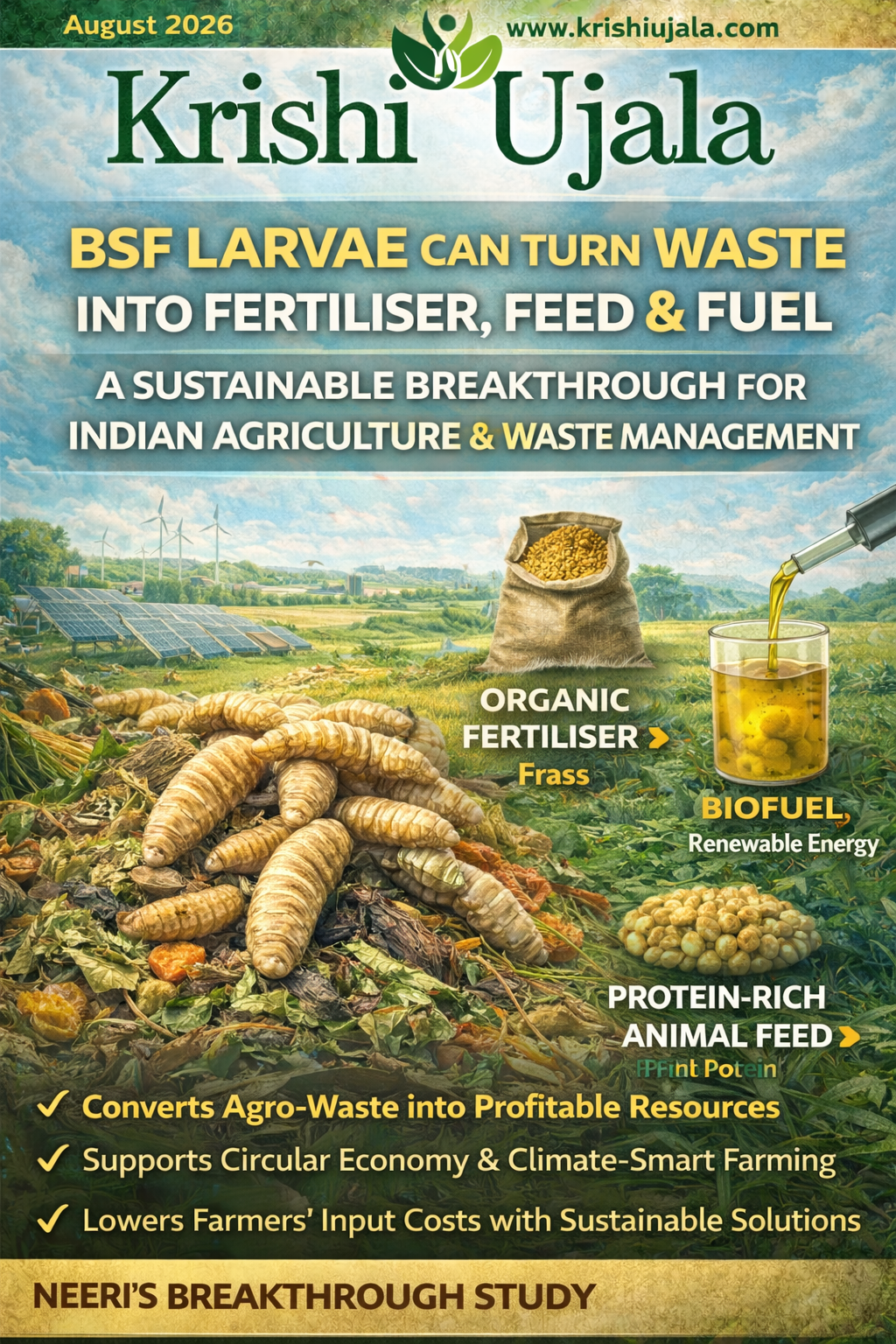
The NEERI study reveals that BSF larvae can efficiently convert organic waste into three valuable resources:
1) Organic Fertiliser (Frass): The residue left after larvae digestion, known as frass, is rich in nutrients such as nitrogen, phosphorus, and organic matter. This makes it an excellent natural fertiliser that improves soil fertility, microbial activity, and crop productivity.
2) High-Protein Animal Feed : BSF larvae are rich in protein and healthy fats, making them a promising alternative to conventional feed ingredients like soybean meal and fishmeal. This can significantly reduce feed costs in poultry, fishery, and livestock sectors.
3) Biofuel and Energy Potential: The fat content extracted from larvae can be processed into bio-oil or biodiesel, offering a renewable energy source and reducing dependence on fossil fuels.
Why This Study Is Important
The findings of the NEERI study are significant for several reasons:
Waste-to-Wealth Approach: Converts organic waste into valuable agricultural inputs, reducing landfill burden and environmental pollution.
Support for Circular Economy: Promotes recycling of nutrients back into agriculture, closing the loop between waste generation and food production.
Reduced Input Costs for Farmers: Provides affordable fertiliser and feed alternatives, especially beneficial for small and marginal farmers.
Climate-Smart Solution: Lowers greenhouse gas emissions associated with waste decomposition and chemical fertiliser production.
Employment & Startup Potential: Opens avenues for rural entrepreneurship, agribusiness startups, and decentralized waste management units.
Relevance to Indian Agriculture
With increasing pressure on soil health, rising fertiliser prices, and sustainability goals, BSF-based systems align perfectly with India’s push toward natural farming, organic inputs, and sustainable agriculture. Integrating this technology at village, institutional, and agro-industrial levels can transform waste management while strengthening farm incomes.
Way Forward
The NEERI study underscores the need for policy support, pilot projects, and awareness programmes to scale up BSF-based waste processing systems. With proper training and infrastructure, this technology can become a game-changer for India’s agri-environmental landscape.
Conclusion
The use of Black Soldier Fly larvae offers a scientifically proven, environmentally safe, and economically viable solution to some of agriculture’s most pressing challenges. By turning waste into fertiliser, feed, and fuel, the NEERI study highlights a future where sustainability and productivity go hand in hand.
Author

Sneha Chand is a B.Sc. (Hons) Agriculture student at G.B. Pant University of Agriculture and Technology, originally from Delhi. She is passionate about giving agriculture a creative and youthful voice by blending field realities with storytelling. Through her writing, she aims to transform agricultural knowledge into meaningful narratives that inform, inspire, and engage readers, particularly the younger generation. Sneha is delighted to contribute to the magazine and be part of a platform that amplifies voices from the field.

I’ve been browsing online more than three hours today, yet I never found any interesting article like yours. It is pretty worth enough for me. Personally, if all website owners and bloggers made good content as you did, the internet will be a lot more useful than ever before.