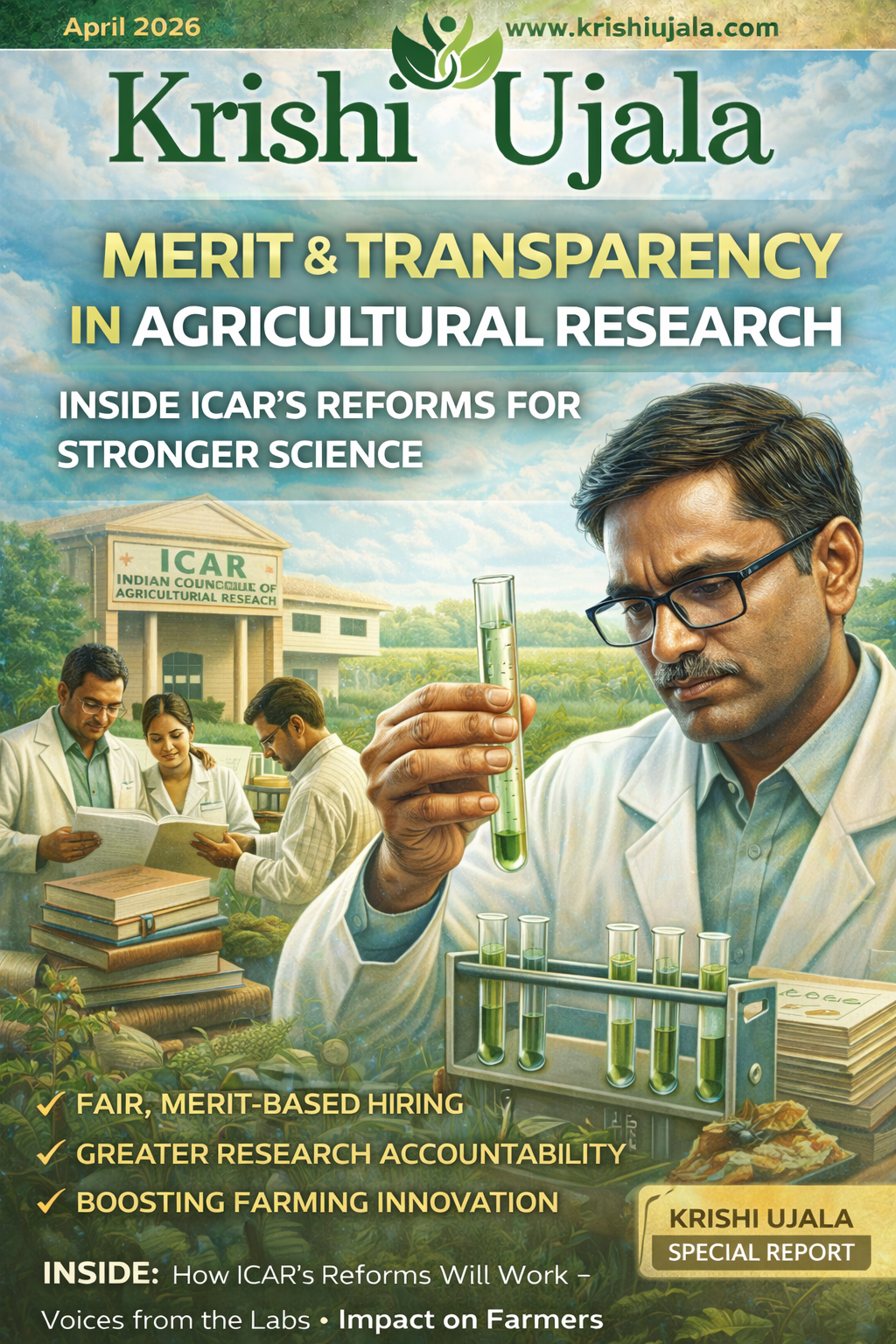
India’s agricultural strength rests not only on the hard work of its farmers but also on the quality of science that supports them. From improved crop varieties and climate-resilient farming practices to pest management and soil health, agricultural research plays a decisive role in ensuring food security for a growing nation. At the centre of this research ecosystem stands the Indian Council of Agricultural Research (ICAR) — the country’s apex body for agricultural science and education.
In recent years, as agriculture has become more complex and technology-driven, ICAR has recognised the need to strengthen its own institutional processes. One such critical area is the selection of scientific and leadership positions, which directly influences the direction and impact of agricultural research. Responding to this need, ICAR has undertaken significant reforms to make its selection system more transparent, objective and firmly rooted in merit.
Why Selection Reforms Were Necessary
For decades, appointments to senior scientific and managerial positions within ICAR followed traditional evaluation methods that relied heavily on interviews and past reputations. While experience and academic standing remain important, experts pointed out that such approaches could sometimes overlook whether a candidate’s skills truly matched the specific requirements of a post.
As agriculture today demands leadership that understands interdisciplinary research, institutional management, farmer engagement and innovation delivery, ICAR acknowledged that the old system needed refinement. Ensuring fairness and accountability in appointments was also essential to maintain the confidence of scientists, students and stakeholders across the country.
A Shift Towards Role-Based Evaluation
To address these concerns, ICAR constituted a high-level committee of experts to review its recruitment and selection practices. Based on the committee’s recommendations, the organisation has introduced a post-oriented selection framework, where candidates are assessed primarily on how well they fit the responsibilities of a specific position rather than on general credentials alone.
Under the new system, each post carries a clearly defined scorecard. Greater weight is given to documented achievements such as research impact, leadership ability, management experience and contribution to institutional growth. Interviews continue to play a role, but their weight has been deliberately reduced to minimise subjectivity and personal bias.
This balanced approach ensures that selections are evidence-based, measurable and aligned with the evolving needs of agricultural research institutions.
Encouraging Leadership and Research Excellence
Another important feature of the reform is the emphasis on research quality and leadership capability. Metrics such as research impact indices, multidisciplinary contributions and work that directly benefits farmers are given due importance. Scientists who have served in challenging regions or contributed to national priorities receive recognition, reinforcing the value of service and commitment.
To further improve fairness, ICAR is also introducing psychometric assessments and training interview panel members to ensure consistency and objectivity in evaluations. Documentation requirements have been simplified, allowing scientists to focus more on research than paperwork.
What This Means for Indian Agriculture
These reforms go beyond administrative efficiency. A transparent and merit-driven selection system strengthens ICAR’s ability to attract and retain capable leaders and researchers who can guide India’s agricultural transformation. Better leadership at research institutions translates into stronger innovation pipelines, faster technology transfer and solutions that are more responsive to farmers’ needs.
In the long run, this can help accelerate progress in areas such as climate-resilient crops, sustainable farming practices, digital agriculture and resource-efficient food production.
Looking Ahead
While the new system marks an important step forward, its success will depend on consistent implementation and periodic review. As agriculture continues to evolve, ICAR’s commitment to transparency and merit will be crucial in keeping India’s research ecosystem dynamic, credible and globally competitive.
By reforming how it selects its leaders and scientists, ICAR is reinforcing a simple but powerful message: strong institutions are built on fairness, clarity and competence. For Indian agriculture, this institutional strength is just as important as seeds in the soil and rain in the field.
Author

Pawni Uprari hails from Lucknow, Uttar Pradesh, and is currently pursuing a B.Sc. (Hons.) in Agriculture at G.B. Pant University of Agriculture and Technology. With a strong academic foundation in agricultural sciences, she has a keen interest in exploring emerging innovations, sustainable practices, and policy-driven advancements in the agricultural sector. She is enthusiastic about contributing insightful articles and research-based content that highlight contemporary developments and support the growth of the farming community.