
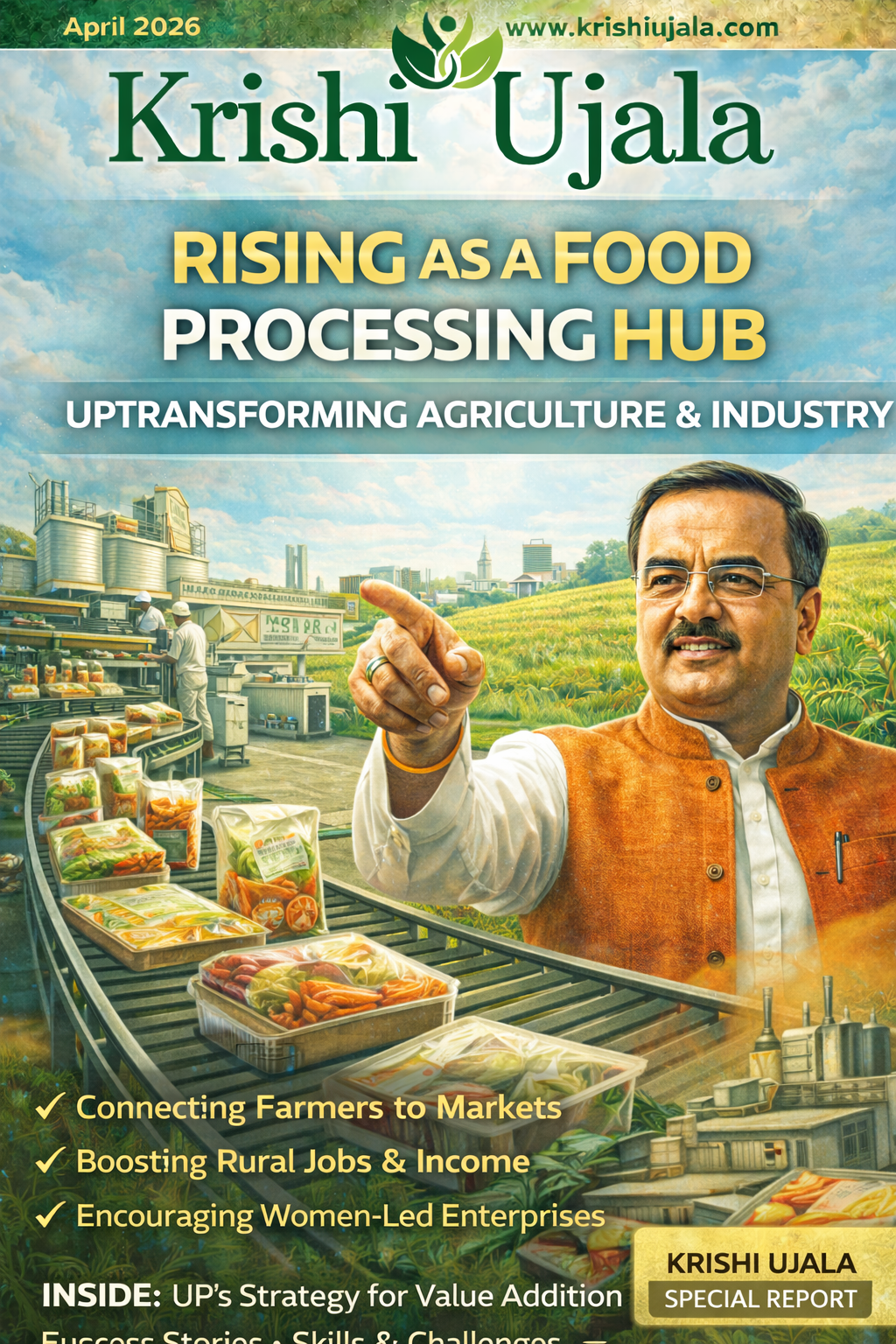
Uttar Pradesh — long recognised as the agricultural heartland of India — is rapidly rewriting its economic story. Traditionally known for its fertile plains and high farm output, the state is now emerging as a major centre for food processing and value-addition, linking farm production with industry, investment and employment. This transition marks a strategic shift from being primarily an agrarian economy to becoming a key driver of agro-industrial growth in the country.
Vision Meets Opportunity
During the India Food Expo 2026 held in Lucknow, Uttar Pradesh Deputy Chief Minister Keshav Prasad Maurya highlighted the state’s ambitions to become a national food processing hub. Addressing farmers, entrepreneurs and industry leaders, he underscored the government’s commitment to creating an investor-friendly ecosystem that bridges agriculture with processing industries. Authorities shared a newly released industrial directory and honoured stakeholders contributing to schemes like the PM Formalisation of Micro Food Processing Enterprises (PMFME).
Maurya emphasised that with strong law and order, supportive policy regimes and expanding economic prospects, Uttar Pradesh offers competitive advantages for industrial and agro-processing investment. By strengthening farmer-industry linkages, the state aims to significantly boost rural incomes and support value addition for local produce.
Alignment with National Goals and Local Strengths
Uttar Pradesh is not building its food processing capacity overnight. Recent data from industry and government sources show a broad push toward advanced infrastructure, technology integration and policy support. A Global Trade Research Initiative report identifies Uttar Pradesh as one of India’s key food processing centres, alongside states such as Gujarat, with over 65,000 processing units currently operating and a combined turnover exceeding ₹2.55 lakh crore. The state has also introduced more than 19 schemes under its Food Processing Policy 2023, along with a single-window clearance system through Invest UP’s Udyog Mitra portal, easing investment procedures for entrepreneurs.
With a strategic goal of establishing at least 1,000 processing units in each district, Uttar Pradesh is fostering regional centres of economic activity that pair agriculture with industry. Districts such as Gorakhpur, Prayagraj, Varanasi and Kanpur are emerging as critical nodes where processing, logistics and market connectivity converge — offering farmers better access to value chains and modern technologies.
Bringing Value to Farmers and Youth
The food processing boom holds several benefits for farmers and rural communities:
- Higher returns for farm produce: Farmers can capture more value by selling raw materials to local processors or engaging in primary processing themselves, reducing dependency on traditional commodity markets.
- Employment generation: Processing units create jobs in rural and peri-urban areas, especially for youth and women, helping reduce rural-urban migration.
- Women-led enterprises: Special incentives — such as up to 90 % subsidies for adopting solar energy technologies in processing operations — encourage women entrepreneurs to enter and expand in the sector.
- Improved food safety and quality: Infrastructure like cold chains, warehouses and modern facilities help maintain quality and reduce post-harvest losses.
Training Tomorrow’s Workforce
Alongside industry growth, educational and training partnerships are playing a role. Collaborations between state food processing departments and institutions such as Babasaheb Bhimrao Ambedkar University (BBAU) aim to nurture skilled professionals who can meet the evolving demands of the food industry. Through hands-on training, research involvement and startup mentoring, such initiatives help bridge knowledge gaps and make Uttar Pradesh a talent hub for agri-processing.
Challenges and the Road Ahead
Despite these successes, challenges remain. Ensuring quality standards, expanding cold chain networks, and improving market access for processed products are ongoing priorities. Furthermore, aligning smallholder farmers with industrial demands requires continuous capacity-building, access to credit and technical support.
Yet, with targeted policy action and collaboration between government, industry and farming communities, Uttar Pradesh is well-positioned to integrate farmers into value chains that amplify incomes and strengthen rural livelihoods.
A Model for Agricultural Transformation
Uttar Pradesh’s push toward food processing is not just an economic strategy — it’s a blueprint for how agrarian states can transform their agricultural strengths into industrial opportunities. From rich harvests to vibrant processing parks, and from village cooperatives to national trade fairs, the state’s journey reflects a broader shift in India’s agricultural landscape — one where value addition, innovation and inclusive growth go hand in hand.
Author

Pawni Uprari hails from Lucknow, Uttar Pradesh, and is currently pursuing a B.Sc. (Hons.) in Agriculture at G.B. Pant University of Agriculture and Technology. With a strong academic foundation in agricultural sciences, she has a keen interest in exploring emerging innovations, sustainable practices, and policy-driven advancements in the agricultural sector. She is enthusiastic about contributing insightful articles and research-based content that highlight contemporary developments and support the growth of the farming community.
Pretty section of content. I just stumbled upon your weblog
and in accession capital to assert that I get actually enjoyed account
your blog posts. Any way I’ll be subscribing to your feeds and even I achievement you access consistently quickly.