
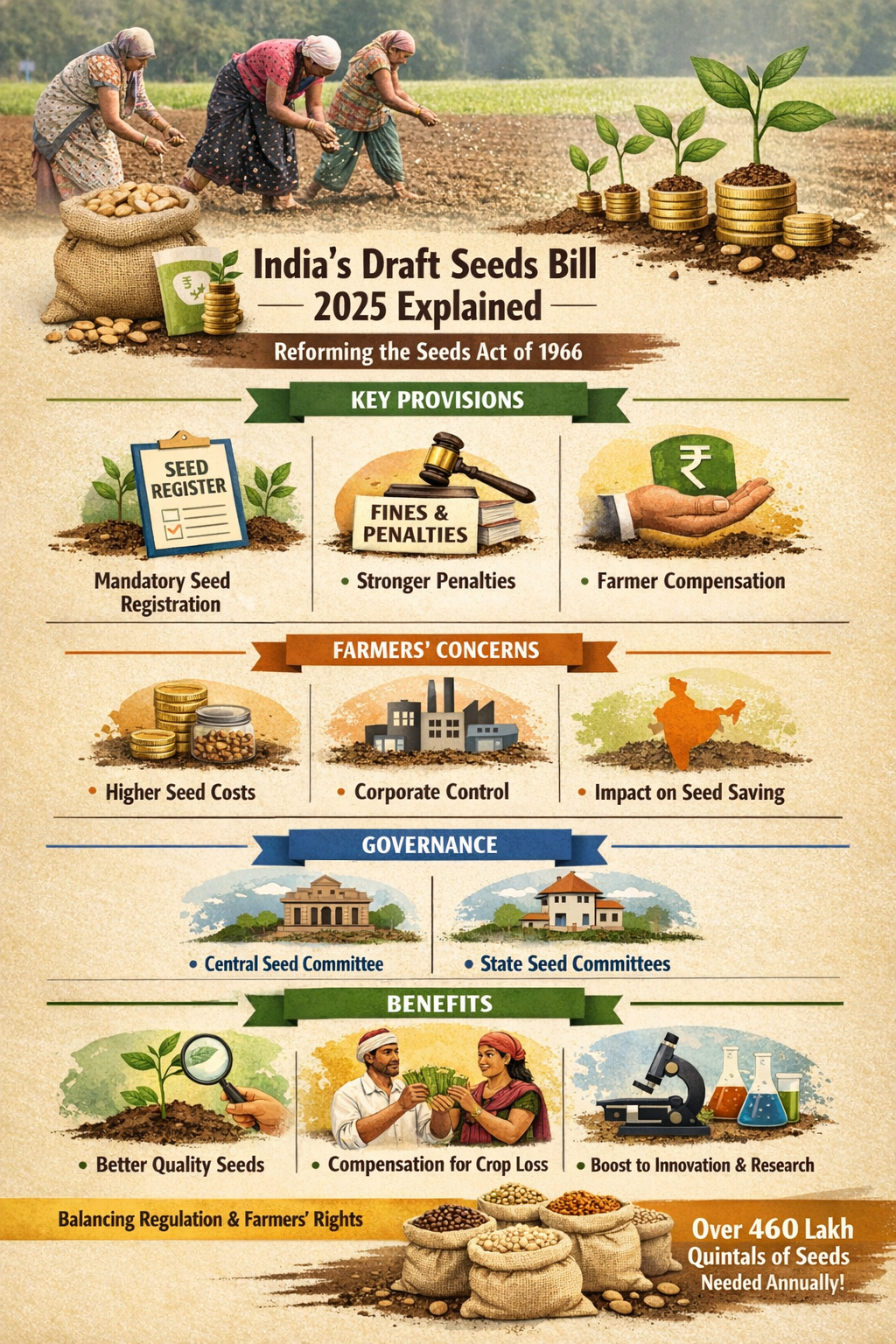
India’s agriculture depends heavily on the quality and availability of seeds. Recognising this, the Union government released the Draft Seeds Bill, 2025, aiming to modernise the Seeds Act of 1966 and the Seeds (Control) Order, 1983. The draft seeks to regulate the seed sector more effectively while balancing farmers’ rights and industry growth.
Why Was Reform Needed?
The Seeds Act of 1966 was framed when:
- The seed industry was small and largely public-sector driven
- Private seed companies and hybrids were limited
- Biotechnology and organised seed markets barely existed
Today, India has:
- A large private seed industry
- Widespread use of hybrids and proprietary varieties
- Rising concerns over seed quality, spurious seeds, and misleading claims
The industry demanded reforms to reduce outdated compliance, while farmers demanded stronger protection against substandard seeds.
What Does the Draft Seeds Bill Propose?
1. Mandatory Registration of Seeds
All seeds sold for commercial purposes must be registered with the government. This ensures:
- Verified quality and performance
- Transparency in seed availability
However, farmer-saved, exchanged, or shared seeds remain exempt, preserving traditional practices.
2. Quality Regulation Without Over-Control
The Bill promotes “ease of doing business” by:
- Simplifying registration
- Allowing self-certification for low-risk categories
- Reducing inspections for compliant companies
At the same time, it empowers authorities to act against serious violations.
3. Strong Penalties for Serious Violations
Unlike the older law, the new Bill introduces graded penalties:
- Monetary fines for minor violations
- Higher penalties for selling misbranded or substandard seeds
- Criminal liability only in cases of repeated or severe offences
This shift reduces harassment while maintaining accountability.
4. Compensation to Farmers
If seeds fail to perform as claimed, farmers can seek compensation. This is a major safeguard, especially for small and marginal farmers who face high risks.
Why Are Farmers’ Groups Worried?
Despite safeguards, farmer organisations have raised concerns:
- Fear that compulsory registration may increase seed costs
- Worries that large corporations could dominate the market
- Concerns over intellectual property indirectly affecting seed saving traditions
The government has clarified that farmers’ rights to save, use, exchange, and sell seeds are protected, but mistrust remains.
Role of Central and State Seed Committees
Central Seed Committee
- Advises the Union government
- Sets national standards
- Coordinates with States
State Seed Committees
- Implement the law at ground level
- Monitor seed quality and distribution
- Address farmer complaints
This decentralised structure ensures both national consistency and local relevance.
Key Benefits of the Draft Seeds Bill
✔ For Farmers
- Better seed quality
- Compensation for crop failure due to faulty seeds
- Protection from spurious and fake seeds
✔ For the Seed Industry
- Simplified regulations
- Reduced compliance burden
- Predictable policy environment
✔ For Indian Agriculture
- Higher productivity
- Improved seed availability
- Boost to innovation and research
The Bigger Picture
India requires over 460 lakh quintals of seeds annually, and with increasing climate risks, seed quality is no longer optional—it is essential. The Draft Seeds Bill attempts to strike a delicate balance between regulation, innovation, and farmer welfare. Its success will depend on transparent implementation and meaningful stakeholder consultation.
Author


Been using 68win14 for a few weeks now. Good selection of slots and live games. Payouts were quick, no issues so far. Check it out, might be your lucky spot: 68win14
Alright, mates! Heard about 13win16 and figured I’d give it a go. Turns out, not bad at all! Easy to navigate and fair odds. I’m no pro, but been enjoying myself there. Give em a try 13win16
Downloaded the b29apk on my phone and I must say now I have access to all the games on the go! A must download for those on the move all the time! b29apk