The Aravalli Verdict Explained: What the Supreme Court’s Decision Really Means
The Aravalli range, India’s oldest mountain system, has long served as a natural shield—recharging groundwater, curbing air pollution, and preventing the spread of desertification across North India. A recent Supreme Court ruling has once again brought the fragile future of this ancient range into sharp national focus, triggering debate over conservation, development, and environmental responsibility.
What the Supreme Court Decided
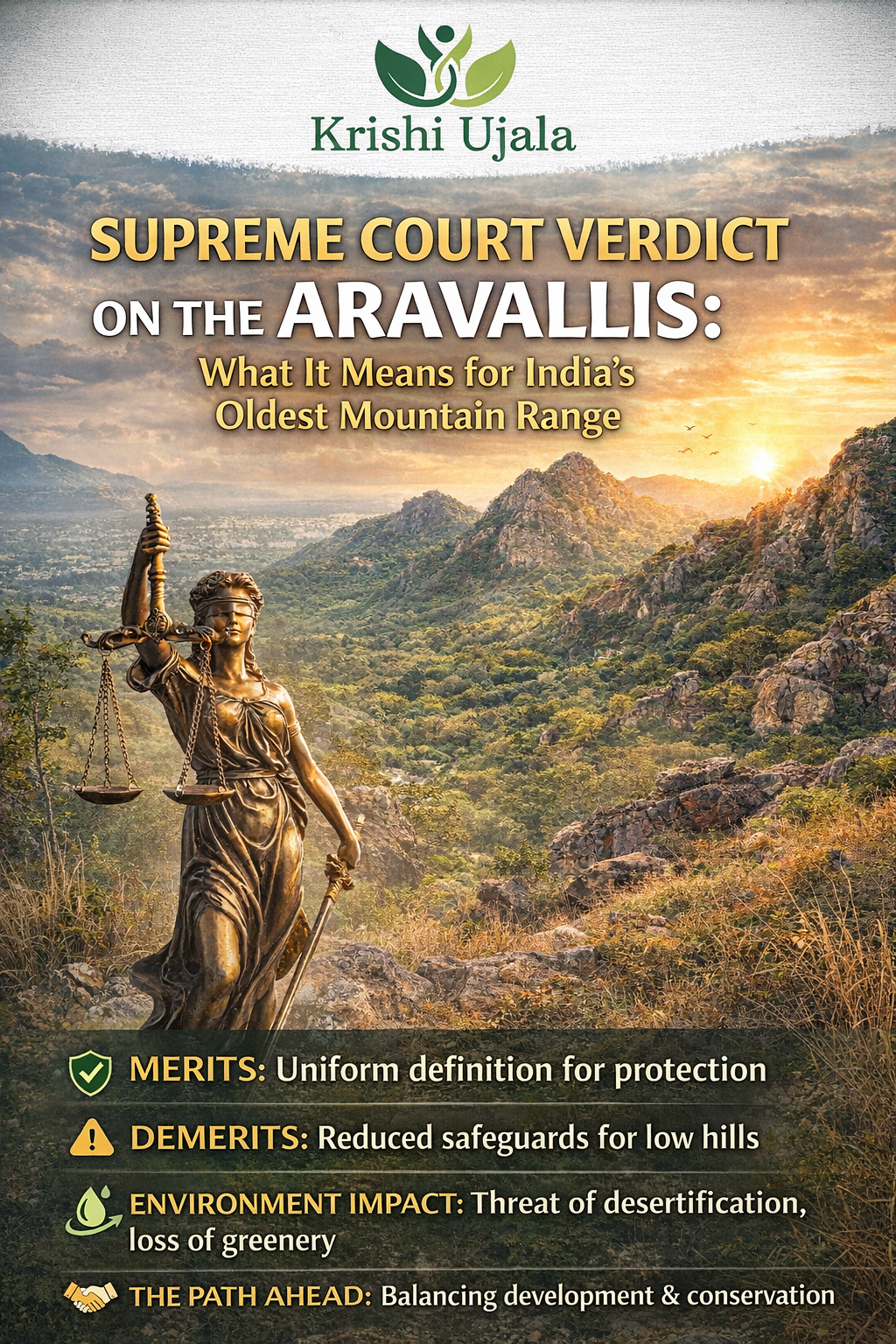
At the heart of the judgment is the Court’s acceptance of the Centre’s definition of the Aravalli hills as landforms rising at least 100 metres above the surrounding terrain. This definition will now guide policy decisions related to mining, construction, and land-use planning across states that fall within the Aravalli belt.
Alongside this, the Supreme Court directed the government to prepare a scientific and sustainable mining management plan and placed restrictions on granting new mining leases until adequate safeguards are put in place. The aim, according to the Court, is to bring consistency and regulatory clarity to long-standing disputes surrounding the region.
Why the Ruling Matters
For decades, conflicting definitions and weak enforcement allowed unchecked mining and construction in many parts of the Aravallis. The new ruling attempts to resolve this ambiguity by introducing a uniform framework for protection and regulation.
Merits of the Decision
One of the biggest advantages of the verdict is legal clarity. A standard definition reduces confusion between states and enforcement agencies, making environmental governance more effective. Clear demarcation of protected areas also strengthens the ability of authorities to act against illegal mining activities.
The government has emphasised that over 90% of the Aravalli region remains protected, reassuring that the core ecological zones are still safeguarded. The judgment also reflects a balanced approach, allowing regulated and sustainable mining where scientifically justified, while recognising economic and livelihood concerns.
Concerns and Environmental Risks
Despite these positives, environmental experts have raised serious concerns. Many ecologically critical low-lying hills, which play a key role in groundwater recharge and biodiversity conservation, may now fall outside the protective framework due to the height-based definition.
There are fears that reduced protection could accelerate desertification, habitat loss, and worsening air pollution, particularly in the Delhi-NCR region. Fragmentation of ecosystems due to mining and construction in newly excluded areas could further weaken the Aravalli landscape.
The Bottom Line
The Supreme Court’s verdict brings long-awaited clarity, but it also opens the door to fresh environmental challenges. Its success will depend entirely on strict enforcement, transparent governance, and science-led planning.
Protecting the Aravallis is not merely a legal obligation—it is a critical investment in India’s environmental security. How this ruling is implemented will determine whether the world’s oldest mountain range continues to protect future generations or slowly fades under the weight of development pressures.
Author

Pawni Uprari hails from Lucknow, Uttar Pradesh, and is currently pursuing a B.Sc. (Hons.) in Agriculture at G.B. Pant University of Agriculture and Technology. With a strong academic foundation in agricultural sciences, she has a keen interest in exploring emerging innovations, sustainable practices, and policy-driven advancements in the agricultural sector. She is enthusiastic about contributing insightful articles and research-based content that highlight contemporary developments and support the growth of the farming community.