Rewriting the Roots: How a Tiny Protein Flip Could Transform Indian Agriculture
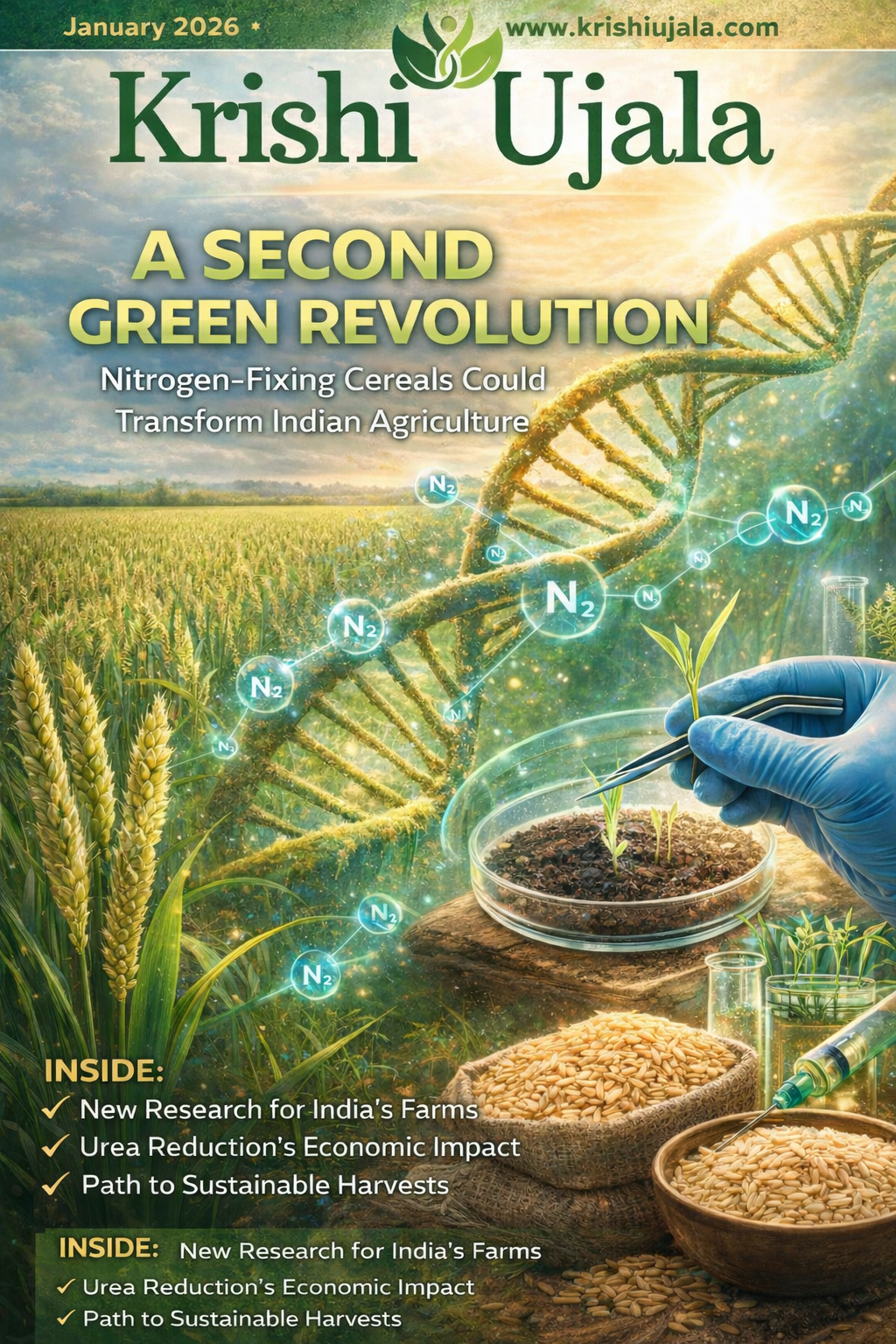
India’s agricultural heartland — from the vast wheat fields of Punjab to the sprawling rice paddies of Eastern Uttar Pradesh — may be on the cusp of one of the most consequential shifts in farming since the original Green Revolution of the 1960s and ’70s. At the centre of this transformation is a remarkable scientific breakthrough: the possibility of enabling cereal crops like rice, wheat and maize to fix their own nitrogen from the air, just like legumes such as beans and peas do naturally.
The Problem With Fertiliser Dependency
For decades, Indian farmers have relied heavily on urea — a nitrogen-rich fertiliser — to sustain the high yields of staple cereals that feed the nation. While effective, this dependency has come at a high cost. The production and application of urea consume vast energy resources, contribute to greenhouse gas emissions, and lead to environmental problems such as groundwater contamination and nitrous oxide release — a greenhouse gas nearly 300 times more potent than carbon dioxide.
On top of this, the financial burden of fertiliser subsidies absorbs tens of thousands of crores of rupees annually. In regions like Punjab, decades of urea runoff have also degraded soil and harmed water quality, presenting a serious challenge to long-term sustainability and environmental health.
A Molecular Switch With Major Impact
What if crops didn’t need so much urea in the first place?
That is the promise revealed by recent research from an international team of scientists. By altering just two amino acids — tiny building blocks of proteins — in specific receptor proteins in cereals, researchers have succeeded in flipping a molecular switch that fundamentally changes how these plants interact with soil bacteria.
In legumes, specialised receptors allow friendly soil bacteria called rhizobia to enter plant roots and form nodules where atmospheric nitrogen is naturally fixed — converted into a form plants can use. Cereals, in contrast, normally recognise those microbes as threats, triggering immune responses that block symbiosis. But with this protein tweak, cereals can instead welcome these helpful bacteria, allowing them to form root nodules and fix nitrogen just like legumes.
This change has already been demonstrated in barley. The next frontier is expanding the technique to core crops like wheat, rice and maize — a leap that could rewrite the physiology of cereal agriculture.
Why This Could Be a Second Green Revolution
Transforming cereals to become self-sufficient in nitrogen isn’t merely a scientific curiosity — it has real economic and environmental promise:
- Massive savings on fertiliser: Even a modest nitrogen fixation of 50 kg per hectare by wheat and rice could save India an estimated ₹40,000 crore annually in fertiliser subsidies alone.
- Lower emissions and cleaner water: Reducing urea dependence could dramatically cut nitrous oxide emissions and ease the burden of soil and water pollution.
- Better resilience for farmers: In areas prone to floods or droughts, where timely fertiliser application is a gamble with the weather, nitrogen-fixing cereals could offer more stable nutrient access.
In essence, this innovation could reimagine nitrogen management — shifting agriculture toward production systems that are both economically efficient and ecologically sustainable.
Bridging Innovation and Regulation
Of course, the road from laboratory discovery to widespread field use is not straightforward. These gene-editing techniques — which precisely tweak plant genomes without necessarily introducing foreign DNA — exist in a regulatory grey zone in many countries, including India. Decision-makers will need to establish clear, science-based frameworks for evaluating gene-edited crops before they can be broadly adopted by farmers.
Looking to the Future
The implications of this research extend beyond nitrogen fixation. As India invests more in agricultural R&D and embraces precision farming tools, digital advisory systems, and sustainable nutrient management, the sector’s evolution could accelerate. Enabling cereals to fix nitrogen represents a quantum leap toward reducing input costs, cutting emissions, and improving soil health — a trifecta of benefits that aligns with global sustainability goals and India’s own food security ambitions.
In the coming decade, this tiny protein flip — a molecular detail invisible to the naked eye — may play a huge role in transforming the fields that feed billions. For Indian agriculture, it’s not just innovation; it’s a chance to reclaim sustainability without compromising production — perhaps marking the dawn of a true Second Green Revolution.
Author

Pawni Uprari hails from Lucknow, Uttar Pradesh, and is currently pursuing a B.Sc. (Hons.) in Agriculture at G.B. Pant University of Agriculture and Technology. With a strong academic foundation in agricultural sciences, she has a keen interest in exploring emerging innovations, sustainable practices, and policy-driven advancements in the agricultural sector. She is enthusiastic about contributing insightful articles and research-based content that highlight contemporary developments and support the growth of the farming community.
I will right away grasp your rss feed as I can’t in finding your email subscription hyperlink or newsletter service. Do you’ve any? Please permit me recognize in order that I may subscribe. Thanks.
Добро пожаловать в Клубника Казино, где каждый игрок найдет для себя идеальные условия для выигрыша и наслаждения игрой. Мы предлагаем широкий выбор игр, включая классические слоты, рулетку, блэкджек и уникальные игры с живыми дилерами. Каждая игра в нашем казино – это шанс выиграть, а безопасность и честность всегда на первом месте.
Почему стоит играть именно в https://clubnikaslots777wins7.top/? Мы предлагаем щедрые бонусы и акции, чтобы каждый игрок мог увеличить свои шансы на победу и насладиться игрой. Кроме того, мы обеспечиваем быстрые выводы средств и круглосуточную поддержку, чтобы вы могли сосредоточиться на игре.
Когда стоит начать играть в Клубника Казино? Не теряйте времени – начните свою игровую карьеру прямо сейчас и получите щедрые бонусы на первый депозит. Вот что вас ждет:
Воспользуйтесь щедрыми бонусами и бесплатными спинами, чтобы начать игру с преимуществом.
Промо-акции и турниры с крупными призами.
Каждый месяц мы обновляем наш ассортимент игр, добавляя новые интересные слоты и настольные игры.
Клубника Казино – это идеальное место для тех, кто хочет играть и выигрывать.
This paragraph provides clear idea in favor of the new users of blogging, that actually how to do blogging.
Thanks – Enjoyed this update, can I set it up so I get an email sent to me every time you make a fresh post?
Unlim Casino предлагает выдающиеся возможности для всех игроков, желающих погрузиться в мир азартных игр. В нашем казино вы найдете великолепную коллекцию слотов, карточных игр, а также интересные акции и турниры, которые помогут вам существенно повысить шансы на выигрыш.
Мы стремимся предоставить вам максимальное удобство опыт, будь то на вашем мобильном устройстве или ПК. Мы ежедневно обновляем коллекцию игр и проводим турниры, чтобы каждый игрок мог найти что-то для себя.
Что вас ждет, если вы присоединитесь к нам?
Простой процесс регистрации — всего несколько кликов, и вы готовы начать играть.
Бонусы для новых игроков — вы получаете бонусы на первый депозит, чтобы начать с максимальными шансами.
Регулярные акции и турниры — для всех, кто хочет получить шанс на крупный выигрыш и дополнительные призы.
Круглосуточная поддержка всегда готова помочь с любыми вопросами, связанными с игрой.
Великолепный выбор игр, доступных на любой платформе — будь то ПК или мобильное устройство.
Не упустите шанс Нас ждут незабываемые выигрыши в Unlim Casino, где вас ждут яркие эмоции и шанс выиграть великолепные призы. Готовы к новым победам?