Introduction
Agriculture is the foundation of human civilization and plays a vital role in ensuring global food security. However, modern agriculture faces several challenges, including a growing population, climate change, declining natural resources, water scarcity, rising production costs, and changing weather patterns. To meet the increasing demand for food while using resources efficiently, agriculture needs innovative and sustainable solutions. One of the most promising approaches is Precision Agriculture.
What is Precision Agriculture?
Precision Agriculture, also known as smart farming, is based on the principle of applying the right input, at the right place, at the right time, and in the right quantity. Traditional farming methods often apply the same amount of water, fertilizers, and pesticides across an entire field. However, soil and crop conditions can vary significantly from one area to another.
Using modern technologies, farmers can identify these variations and make better decisions. For example, a sensor may indicate that one part of a field requires more irrigation while another area already has sufficient moisture. This allows farmers to use water efficiently and avoid unnecessary wastage.
Technologies Used in Precision Agriculture:
1. GPS and Geographic Information Systems:
GPS technology helps farmers accurately identify locations within their fields. Geographic Information Systems (GIS) can be used to create detailed maps showing soil conditions, crop growth, nutrient levels, and other important factors.
2 . Drones and Satellite Imagery:
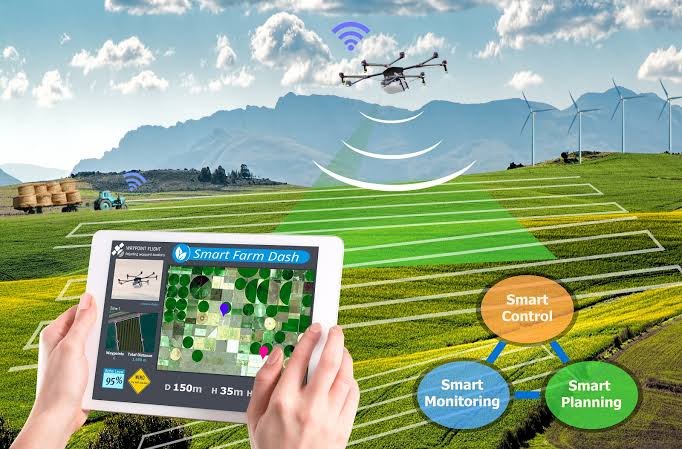
Drones can capture high-quality images of agricultural fields and help farmers monitor crop growth, pest attacks, diseases, and water stress. Satellite imagery can also provide valuable information about large agricultural areas.
3. Artificial Intelligence and Data Analysis:
Artificial intelligence can analyze large amounts of agricultural data and identify patterns that may not be easily visible to humans. AI-based systems can help predict crop diseases, estimate yields, and recommend suitable management practices.
Benefits of Precision Agriculture:
1.Precision agriculture offers several important benefits for farmers, consumers, and the environment
2 One major advantage is the efficient use of resources. Farmers can reduce unnecessary use of water, fertilizers, pesticides, fuel, and labour. This can lower production costs and improve farm profitability.
3.Precision agriculture can also increase crop productivity. By identifying problems at an early stage, farmers can take timely action against pests, diseases, nutrient deficiencies, and water stress.
Challenges in Adoption
● Despite its advantages, precision agriculture faces certain challenges. Advanced technologies can be expensive, making them difficult for small and marginal farmers to adopt. Farmers may also require training to understand and use digital technologies effectively.
● Custom hiring centres, farmer cooperatives, mobile-based agricultural applications, and government support programs can help smaller farmers benefit from modern technologies.
Precision Agriculture and the Future of Food Production:
The world’s population continues to grow, increasing the demand for safe, nutritious, and affordable food. At the same time, agricultural land and freshwater resources are limited. Therefore, future food production must focus not only on producing more food but also on producing it sustainably.
Precision agriculture can play an important role in achieving this goal. Smart technologies can help farmers increase production from existing farmland while reducing resource consumption. Data-driven farming can improve efficiency and make agriculture more resilient to climate change.
In the future, farms may become increasingly automated. Drones may regularly monitor crop health, sensors may automatically control irrigation systems, and artificial intelligence may provide farmers with real-time recommendations. Robotics may also assist with activities such as weeding, harvesting, and crop monitoring.
Conclusion:
Precision Agriculture represents an important step toward the future of food production. By combining agriculture with technologies such as sensors, drones, GPS, artificial intelligence, and automation, farmers can use resources more efficiently and improve productivity.
The future of agriculture will depend on the ability to produce sufficient food while protecting natural resources and the environment. Precision agriculture offers a practical pathway toward sustainable, efficient, and technology-driven food production. With proper investment, farmer education, and infrastructure development, it has the potential to transform agriculture and contribute significantly to global food security.
In the future, successful farming will not only depend on working harder, but also on farming smarter.
Author

B.Sc. Agriculture student with a keen interest in agricultural content writing and scientific communication. With a passion for agriculture, farming techniques, and sustainable practices, they enjoy creating informative and engaging content that makes agricultural knowledge accessible to a wider audience. They are continuously developing their writing and communication skills with the aim of combining their agricultural background with content creation and contributing meaningfully to the field of agriculture.