
For years, the story of stubble burning in India revolved around Punjab. Winter smog, satellite
images, and public outrage consistently pointed towards the north-west. But 2025 has
rewritten that script.
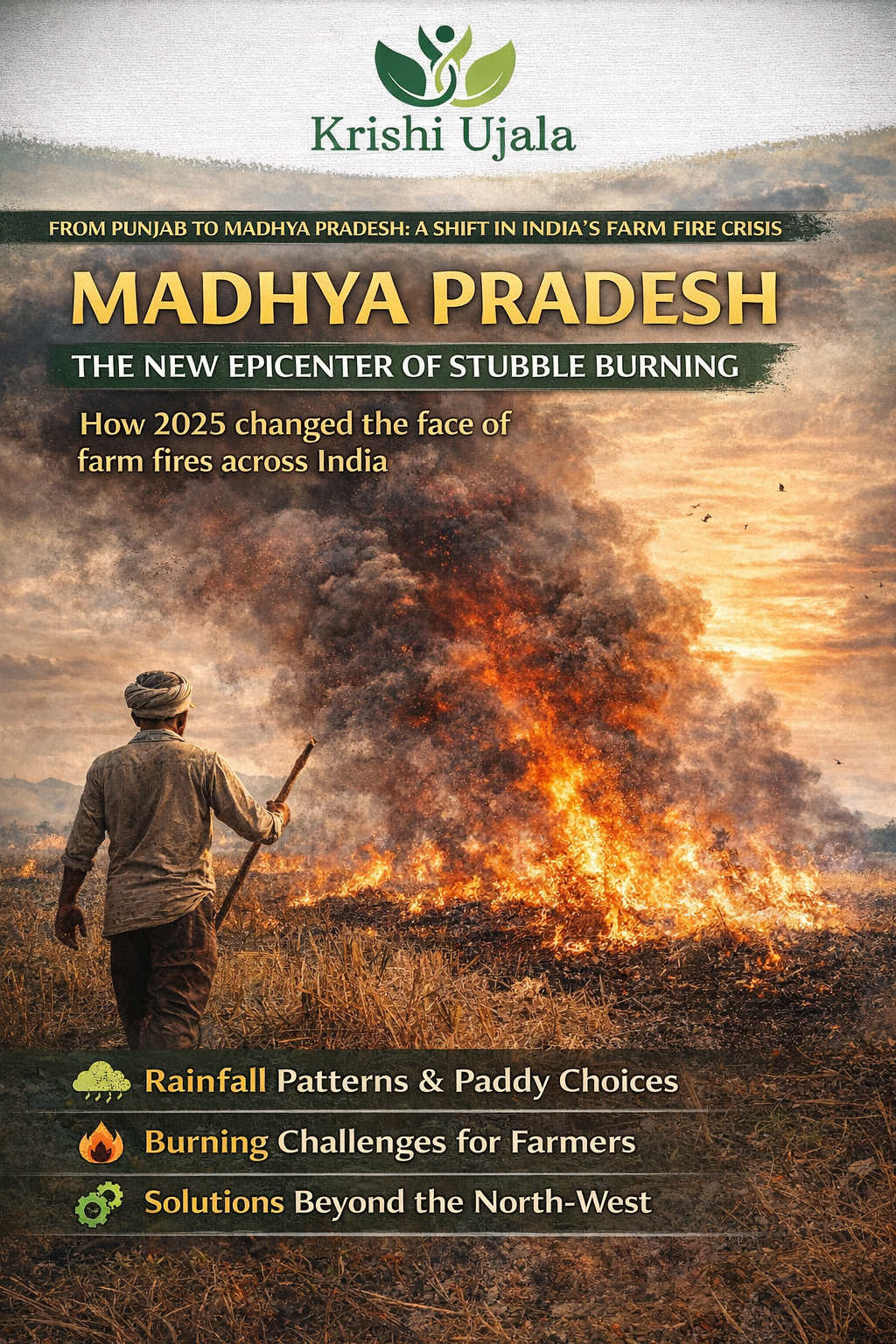
This year, Madhya Pradesh recorded nearly three times more paddy stubble burning
incidents than Punjab, emerging as the country’s most active hotspot for farm fires — not due
to neglect, but because of changing rainfall patterns and shifting crop choices.
Satellite data from ICAR-IARI’s CREAMS dashboard reveals that 14,708 stubble burning
incidents were recorded in Madhya Pradesh between September 15 and November 26, 2025,
compared to 5,095 incidents in Punjab during the same period.
Rain Changed the Crop — and the Consequences Followed
In recent years, Madhya Pradesh has experienced increasing and more consistent monsoon
rainfall, making paddy cultivation economically attractive even in regions where it was once
limited.
“When rainfall becomes reliable, farmers naturally move towards crops with assured returns,”
explains an agricultural climate expert.
“Paddy fits that equation — but its residue burden is enormous.”
Unlike wheat or pulses, paddy leaves behind thick straw that farmers must remove quickly to
prepare fields for the next crop. With limited time, labour, and machinery, burning becomes
the quickest solution.
Punjab’s Decline Signals Progress — Not Victory
Punjab’s comparatively lower numbers in 2025 reflect years of focused intervention —
residue management machines, penalties, monitoring, and social pressure.
“Punjab shows that policy works when it is sustained,” says an environmental researcher.
“But it also proves that the problem doesn’t disappear — it migrates.”
As pressure mounted in the north-west, central India quietly absorbed the impact, without
receiving equal policy attention or infrastructure support.
Why Madhya Pradesh Is Struggling ?
Several structural factors make Madhya Pradesh more vulnerable:
Limited access to crop-residue machinery .Smaller and fragmented landholdings Lower enforcement intensity Less public visibility of air-pollution impacts
A field-level extension worker sums it up simply:
“Burning isn’t a preference. It’s the only option many farmers can afford.”
Local Smoke, Long-Term Damage
While these fires may not directly choke metropolitan cities, their local environmental cost is
severe — loss of soil nutrients, rising respiratory problems, and increased carbon emissions.
Scientists warn that expanding fire zones will complicate India’s pollution-control strategies,
especially as climate change continues to reshape agricultural geography.
Rethinking the National Response
The 2025 data sends a clear message: stubble burning is no longer a regional issue.
“Policies must move faster than climate change,” notes a rural development specialist.
“Supporting farmers with alternatives will reduce fires more effectively than punishment.”
A sustainable solution requires:
Expanding residue-management infrastructure beyond Punjab Incentivising crop diversification Making residue utilisation economically viable
A New Fire Map for India
Madhya Pradesh’s rise as the leading state in stubble burning marks a turning point in India’s
agricultural and environmental narrative. The smoke has shifted — and policy must follow.
Unless addressed now, today’s silent fires may become tomorrow’s national crisis.
Author