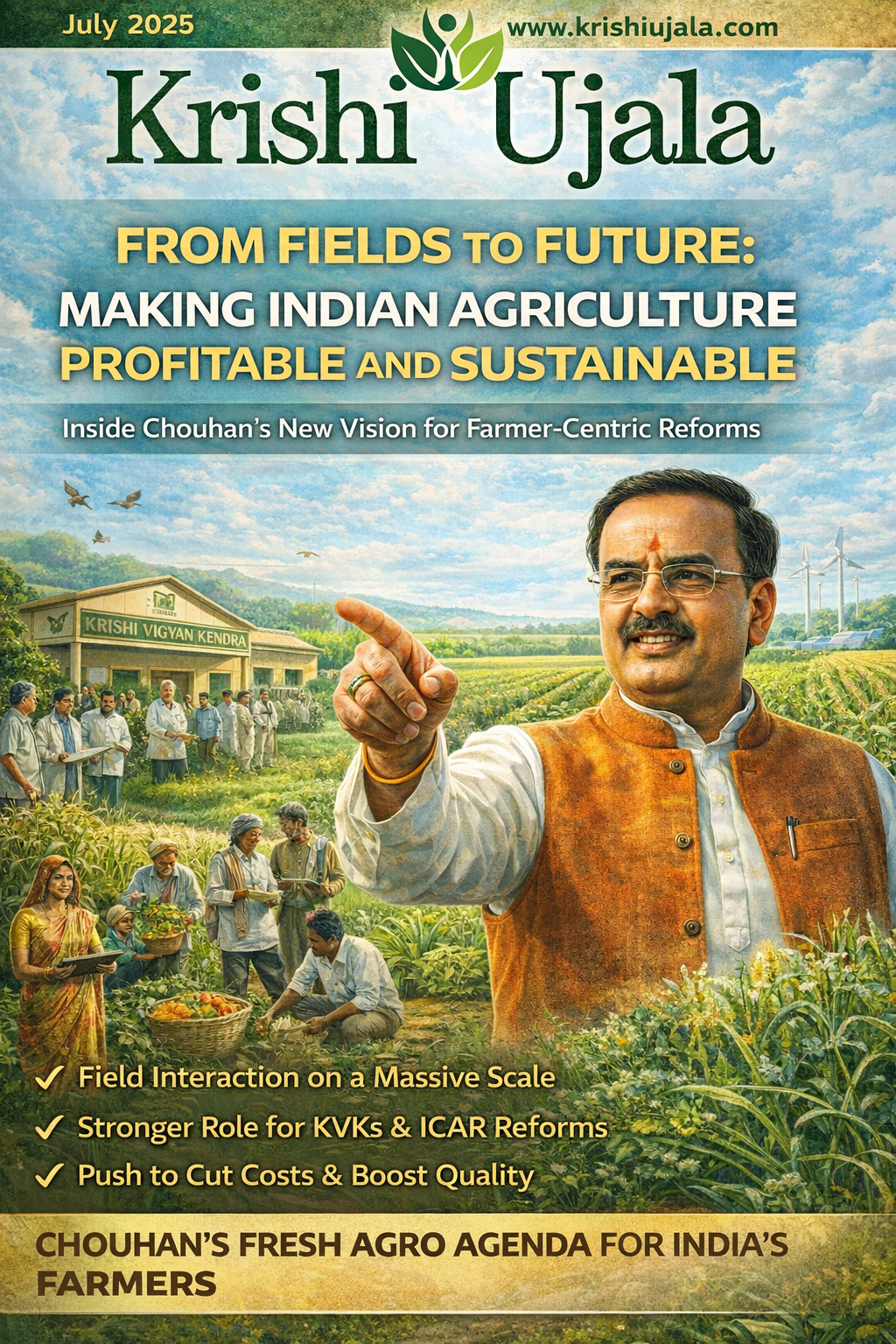
At a time when Indian farming faces both promise and challenge — from global market pressures to climate-linked risks — the government is pushing forward with a farmer-centric reform agenda that seeks to make agriculture not just productive but also profitable, sustainable and future-ready.
Union Agriculture Minister Shivraj Singh Chouhan recently outlined a suite of initiatives aimed at transforming the way Indian agriculture functions — from research engagement at the grassroots to institutional strengthening, quality control and long-term livelihood strategies. These efforts reflect a strategic shift toward inclusive, science-driven agricultural growth that empowers farmers at every stage of the value chain.
The Power of Farmer Engagement
Central to the minister’s approach is the belief that agriculture reform cannot be driven from bureaucratic offices alone; it must be rooted in direct interaction with farmers. To this end, Chouhan emphasised his commitment to regular farm visits — spending two days a week in the field — to better understand real challenges and opportunities on the ground.
This philosophy was embodied in the recently concluded Viksit Krishi Sankalp Abhiyan, a nationwide outreach campaign that brought together agricultural scientists, government officials and expert teams to work directly with farmers across India. Over 2,170 multidisciplinary teams visited more than 1.42 lakh villages, interacting with more than 1.34 crore farmers to identify problems and co-design solutions.
The campaign’s interactive format — including Kisan Chaupals, where farmers and scientists discussed soil health, crop suitability, pest management and climate impacts — offered a unique platform for two-way learning and reinforced the idea that practical field insights must shape policy decisions.
Revamping Institutional Support
A key outcome of this engagement model is a more responsive agricultural ecosystem, anchored by regional coordination and scientific backing. In a bid to strengthen implementation and policy outreach, Chouhan announced that the Indian Council of Agricultural Research (ICAR) will appoint state-level nodal officers tasked with overseeing scientific trials, guiding region-specific prioritisation and maintaining closer liaison with state governments.
At the district level, Krishi Vigyan Kendras (KVKs) — the government’s frontline agricultural extension units — have been designated as nodal agencies responsible for coordinating teams that directly address farmers’ needs. Scientists from these centres are now expected to spend a significant portion of their time in the field, ensuring research solutions align closely with local realities.
Quality Control and Cost Reduction
Field consultations also highlighted systemic issues affecting farmers’ profitability, such as the prevalence of substandard seeds and pesticides. In response, the government has pledged to strengthen the Seed Act and tighten quality control to ensure that only certified, high-quality inputs reach farmers. This effort is part of a broader strategy to reduce input costs and boost crop yields sustainably.
Reducing production costs remains a central pillar of Chouhan’s vision, even as the government works to improve infrastructure, foster market linkages, expand technology adoption and promote balanced fertiliser use — all with the goal of increasing net returns for farmers.
Reaching the Underserved
The outreach efforts under the Viksit Krishi Sankalp Abhiyan were particularly notable for their scale and inclusivity. The campaign placed a strong emphasis on historically under-served regions — from tribal districts to aspirational blocks and border areas — to ensure no community was left behind. In tribal districts alone, more than 8,000 programmes were conducted, covering thousands of villages and engaging millions of farmers.
Through these dialogues, farmers voiced concerns about climate change adaptation, organic certification procedures, fodder policies and the effectiveness of Farmer Producer Organisations (FPOs). The minister acknowledged that such feedback will influence the Ministry’s future agenda, anchoring policy in grassroots realities.
A Broader Agricultural Vision
Reflecting on India’s agricultural progress, Chouhan highlighted structural achievements under recent policy regimes, noting that foodgrain production has increased by nearly 40 % over the past decade — a testament to data-driven and farmer-centric policymaking. He underscored the government’s broader vision of positioning India as a global food basket, driven by synergy between policy, science and grassroots participation.
Passionate about aligning policy with impact, the minister’s initiatives aim to build a sustainable agricultural sector that not only meets the needs of a growing population but also enhances farmers’ livelihoods, resilience and economic stability.
Conclusion: A Holistic Transformation
The suite of schemes launched by Shivraj Singh Chouhan signals a holistic transformation of Indian agriculture, anchored in direct farmer engagement, quality enhancements, scientific integration and institutional responsiveness. By bringing science out of the lab and into farmers’ fields, the government hopes to create an agricultural ecosystem that is equitable, profitable and prepared for the challenges of the 21st century.
The future of Indian agriculture, as envisioned by Chouhan, lies in collaboration — between scientists and farmers, policy and practice, data and decision-making. This ground-up approach could well be the catalyst that turns farming into a sustainable, profitable and resilient livelihood for millions across the country.
Author

Pawni Uprari hails from Lucknow, Uttar Pradesh, and is currently pursuing a B.Sc. (Hons.) in Agriculture at G.B. Pant University of Agriculture and Technology. With a strong academic foundation in agricultural sciences, she has a keen interest in exploring emerging innovations, sustainable practices, and policy-driven advancements in the agricultural sector. She is enthusiastic about contributing insightful articles and research-based content that highlight contemporary developments and support the growth of the farming community.

I like this post, enjoyed this one thanks for posting.