
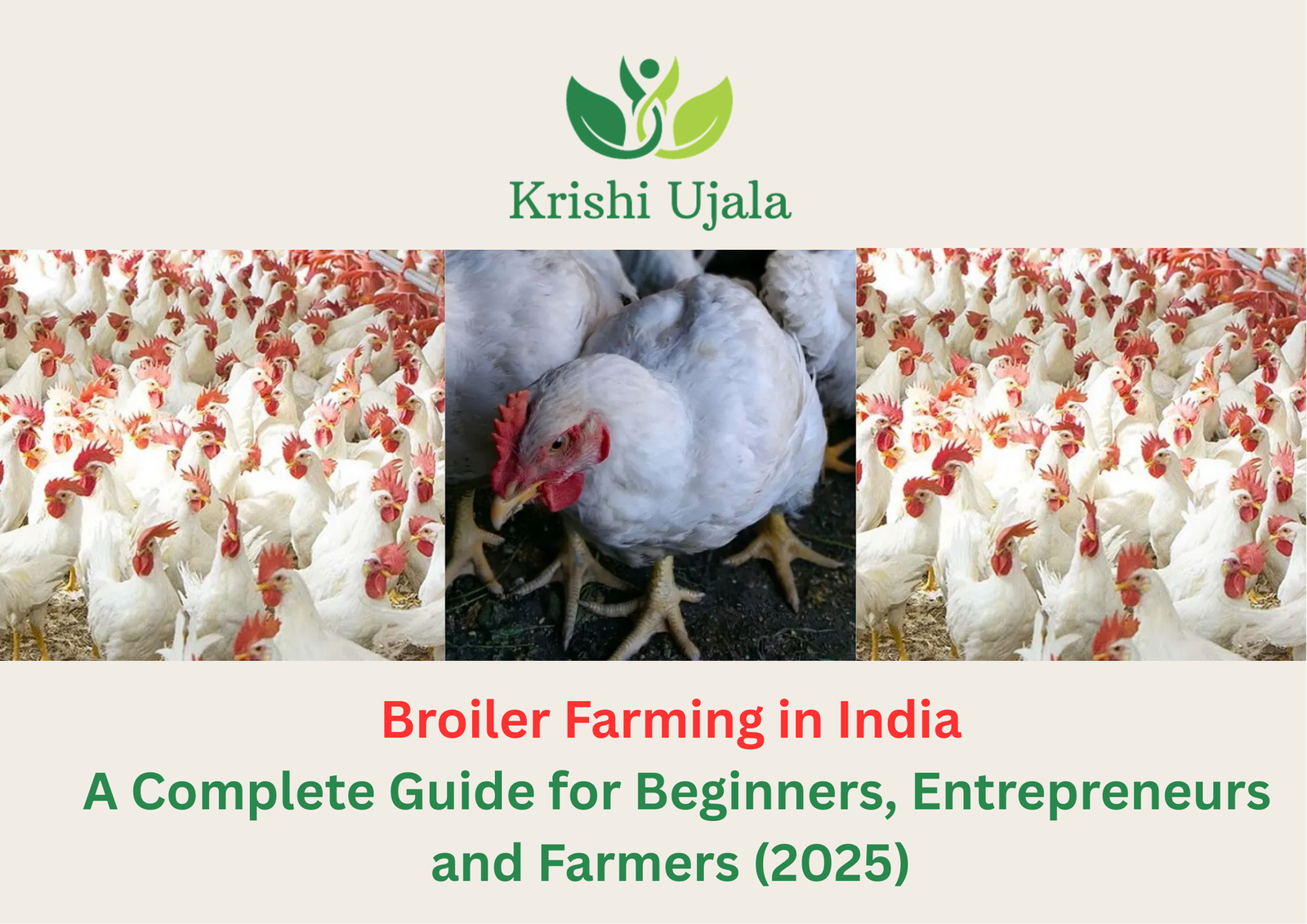
Broiler Farming in India: A Complete Guide for Beginners, Entrepreneurs, and Farmers (2025)
Your ultimate guide to profitable and sustainable broiler poultry farming
Broiler farming has become one of the most profitable and fast-growing livestock enterprises in India. With rising meat consumption and steady market demand, broiler poultry farming offers excellent income opportunities for farmers, youth entrepreneurs, women SHGs, and rural startups. Broilers grow rapidly—reaching market weight in just 35–45 days, making it a quick-return venture with high scalability.
Why Broiler Farming is a Great Business Opportunity
Broiler farming is popular because of its low investment, high returns, and guaranteed market. Key advantages include:
- ✔ Fast growth and short production cycle
- ✔ High demand for chicken throughout the year
- ✔ Low space requirement compared to other livestock
- ✔ Uniform market rates with better price visibility
- ✔ Suitable for small to large farmers
- ✔ Quick return on investment (ROI)
Broiler farming also creates local employment and supports rural economic development.
Getting Started: Housing and Management
Good housing ensures healthy birds and reduces mortality.
🏠 Housing Requirements
- Provide 0.8–1 sq ft per bird
- Maintain proper ventilation with side curtains
- Use dry litter like paddy husk
- Install brooders for day-old chicks
- Maintain proper lighting (23 hours light during first week)
🔥 Brooding Temperature
- Week 1: 32–34°C
- Reduce 2–3°C weekly until birds feather out
Provide round feeders and clean water at all times.
Broiler Feed & Nutrition
Feeding plays a major role in broiler weight gain.
Feed Stages
- Starter feed (0–14 days): 22–23% protein
- Grower feed (15–28 days): 20–21% protein
- Finisher feed (29 days–market): 18–19% protein
Feed Tips
- Use good quality commercial feed
- Avoid sudden diet changes
- Provide clean, cool water
- Add electrolytes & vitamins during heat
Good nutrition ensures fast growth and better FCR (Feed Conversion Ratio).
Biosecurity & Disease Management
Broilers are sensitive to infections; prevention is better than cure.
Common Diseases
- Newcastle Disease (Ranikhet)
- Gumboro
- Coccidiosis
- CRD (Chronic Respiratory Disease)
Vaccination Schedule
| Age | Vaccine |
|---|---|
| Day 1 | Marek’s |
| Day 7 | Lasota (Ranikhet) |
| Day 14 | Gumboro |
| Day 21 | Gumboro Booster |
| Day 28 | Lasota Booster |
Biosecurity Practices
- Use footbaths
- Restrict visitor entry
- Disinfect equipment regularly
- Maintain dry litter
- Quarantine sick birds
Strong biosecurity reduces mortality and improves profits.
Economic Analysis: Profit from 100 Broilers
| Item | Cost (₹) |
|---|---|
| 100 chicks (₹40 each) | ₹4,000 |
| Feed | ₹5,500 |
| Medicines | ₹500 |
| Electricity & labour | ₹500 |
| Total Cost | ₹10,500 |
Income
100 birds × 2 kg × ₹90/kg = ₹18,000
Net Profit in 40 Days
👉 ₹7,500 per batch
Profit increases with better management and higher market prices.
Marketing Channels for Broilers
- Local meat shops
- Hotels & restaurants
- Direct consumer sales
- Mandis
- FPO-based collective marketing
Maintaining good buyer relationships ensures better rates.
Tips for Success in Broiler Farming
- Buy chicks from reputed hatcheries
- Provide continuous clean water
- Keep litter dry
- Avoid overcrowding
- Follow vaccination schedule strictly
- Keep daily records of feed, mortality, and growth
Small improvements in management lead to big improvements in profit.
❓ Frequently Asked Questions (FAQs)
1. Is broiler farming profitable in India?
Yes. Due to high demand and fast growth, broiler farming is one of the most profitable livestock businesses, offering returns in 35–45 days.
2. How many broilers can I start with?
Beginners can start with 100–200 birds. It requires low investment and minimal space.
3. What is the survival rate in broiler farming?
With good management, survival rates of 94–97% are achievable.
4. What is the best feed for broiler chickens?
Commercial broiler feed with balanced protein and energy is recommended. Ensure separate starter, grower, and finisher feeds.
5. How much space is needed for 100 broilers?
Approximately 80–100 sq. ft. is sufficient.
6. What is the main cause of mortality in broilers?
Poor brooding management, wet litter, and weak biosecurity are the major causes.
7. How many batches can I produce in a year?
You can produce 7–8 batches per year, depending on your management.
8. Do I need a license for broiler farming?
For small-scale (<2,000 birds), no license is required in most states.
Large farms must follow pollution and local regulatory guidelines.
9. What is FCR in broiler farming?
Feed Conversion Ratio (FCR) indicates feed efficiency.
A good FCR is 1.6–1.8.
10. How can I increase my broiler profits?
- Reduce feed wastage
- Maintain ideal temperature
- Improve biosecurity
- Sell during high-demand periods
- Buy chicks from reputed hatcheries
Conclusion
Broiler farming is an excellent income-generating enterprise for farmers, youth, and rural entrepreneurs. With proper planning, scientific management, and good hygiene, broiler poultry farming can deliver consistent profits year-round. Whether you’re starting small or expanding into a commercial setup, broiler farming offers immense potential for sustainable livelihood development.
Author

Gagan Tripathi is an agripreneur, plant scientist, and author known for his work in agritech innovation and sustainable horticulture. He is the Co-founder and CEO of Plant Orbit, a horticulture-focused startup dedicated to making healthy, scientifically managed plants accessible to urban and institutional consumers. Born in 2000, Gagan holds a master’s degree in Agriculture Extension and Communication, blending agricultural science with entrepreneurship and community outreach. He is also the author of the bestseller “Roadmap to Your Healthy Succulents”. His work focuses on sustainable plant care, green entrepreneurship, and building impact-driven agri startups in India.

Nicely put, With thanks.
My page; https://fintechbase.icu/
現代日本は、最先端のテクノロジーにおいて世界的に有名されています。特に、自動車産業では、トヨタなどの大手企業が世界市場をリードしており、高性能車や電気自動車など、さまざまな環境に配慮した技術が導入しています。自動車技術の進展により、燃費が大きく向上し、ドライバーにとってより良い選択肢が提供されています。
バイクの所有は、自動車税といった日本特有の制度に密接に関連しており、日本の交通システムは、これらの制度に従い、運転のルールを確保しています。さらに、ドライブレコーダーの普及が進んでおり、事故やトラブルの際に迅速に対応できるようになっています。これにより、日本全土では、安全性が提供され、安全運転の問題にも積極的に取り組んでいます。
一方で、高齢化社会という重要な問題が日本において進行しています。高齢者の増加に伴い、介護分野での需要が急増し、医療スタッフの不足が深刻な問題となっています。このため、看護師求人が増加しており、さらに介護職の再教育の需要も高まっています。政府は、AI技術を活用した支援策を導入し、高齢者への支援を強化しています。
また、医療の分野では、治療法が急速に進化し、健康管理に対する対応が向上しています。日本は、高い医療水準を提供し、特にがん治療において多くの技術革新が導入されています。さらに、看護師の専門性を高めるため、看護師国家試験が重要視され、専門知識の充実が求められています。
社会的な課題に対して、日本のNPOは積極的に取り組んでおり、地域活性化を推進しています。これにより、地域住民や障害者に対する支援が強化され、ボランティア活動が日常的に行われています。地域支援活動も重要な役割を果たしており、特に日本では、地震などの自然災害時に、支援団体が迅速に対応し、支援活動が行われています。
さらに、デジタル化が進展する中で、スマホゲームなどの新たな娯楽の形態が広がり、健康管理への関心が高まっています。日本では、家庭用トレーニングの利用が増加し、美しい体作りに向けたライフスタイルが注目されています。また、サプリメントが重要な役割を果たし、健康的な食生活のためのアイテムが多く流通しています。
ファッションや美容においても、日本は、常に新しいトレンドを追い求めています。靴においては、ファッションデザイナーが注目され、特にフォーマルスタイルが人気です。美容業界では、メイクが進化し、脱毛などのサービスも充実しています。ネイルアートやジェルネイルもトレンドとなり、ネイルサロンが活況を呈しています。
このように、現代日本は、進展とともに進化しており、社会福祉が密接に関わり合っています。未来に向けて、持続可能な社会の実現に向けた取り組みが進んでおり、これらの挑戦を乗り越えるための準備が整いつつあります。
Nicely put. Many thanks.
You’ve made your stand very effectively.!