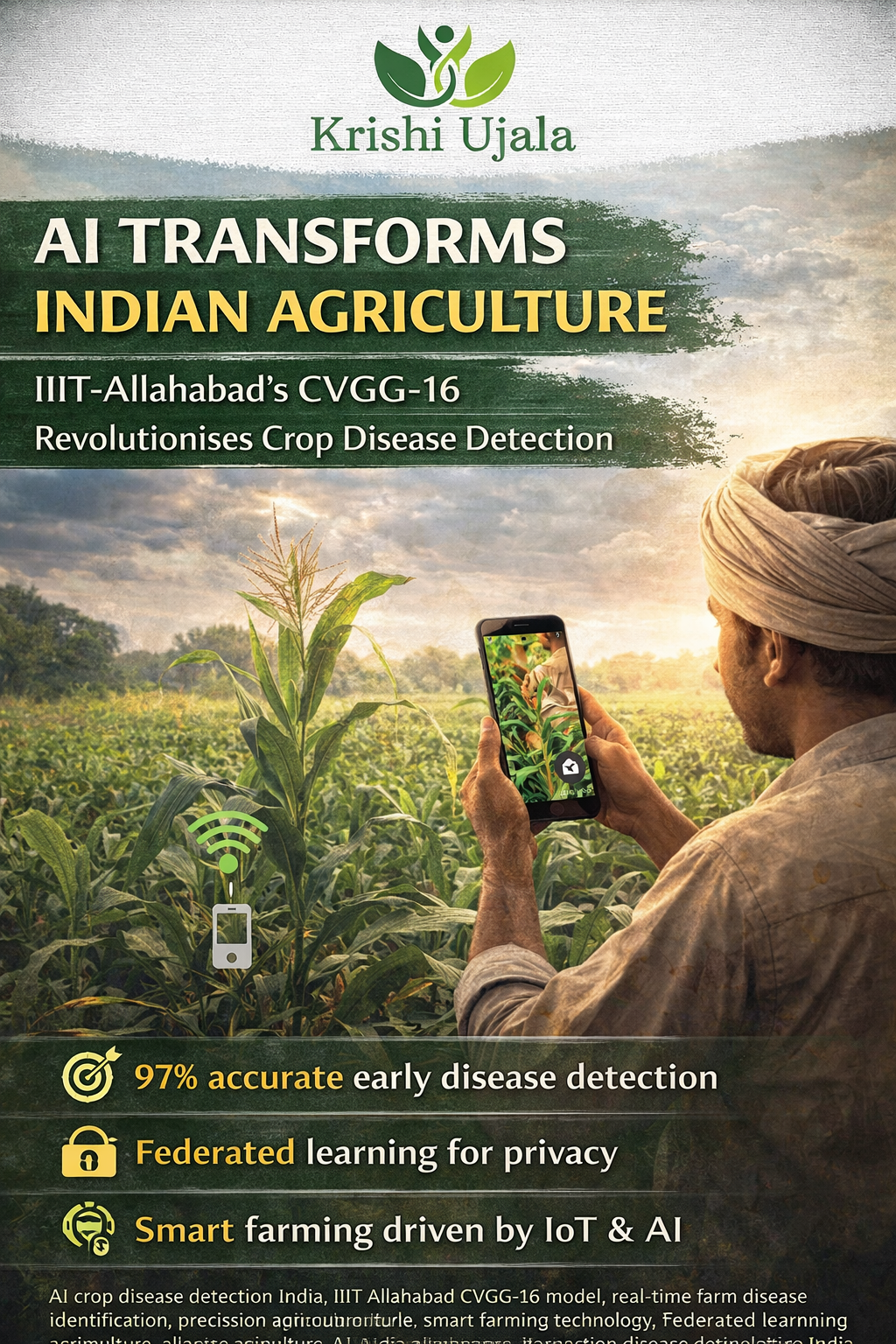
In a major breakthrough for precision agriculture in India, researchers at the Indian Institute of Information Technology Allahabad (IIIT-A) have developed a cutting-edge artificial intelligence system that allows farmers to detect crop diseases in real time, directly in the field — even under challenging environmental conditions. This innovation, known as CVGG-16, marks a significant step toward smarter, data-driven farming that could reduce crop losses, cut input costs, and make disease management more efficient and accessible for small and marginal farmers.
What Is CVGG-16 and How It Works
The CVGG-16 system is a deep learning-based model designed specifically for crop disease detection in real-world agricultural environments. Unlike traditional methods that rely on manual inspection or expert agronomists, this AI-powered solution harnesses the latest advancements in:
- Artificial Intelligence (AI) and Deep Learning
- Internet of Things (IoT)
- Federated Learning
to analyze both visual crop data and environmental conditions to deliver accurate and early disease diagnoses.
While many image-based disease models only examine leaf images, CVGG-16 goes a step further by fusing multiple data streams — including leaf images, soil moisture, temperature, humidity, and weather patterns — into a unified analytical system. This broader context makes its predictions more robust and reliable, even in dusty, low-light, or weather-affected farm conditions.
Impressive Accuracy and Field Results
After training on real farm data from regions around Prayagraj, the CVGG-16 model demonstrated remarkable performance:
- 97.25 % overall accuracy in detecting crop diseases
- 96.75 % accuracy specifically for maize diseases
- 93.55 % accuracy for potato disease identification
These high accuracy rates show the model’s potential to catch early disease symptoms well before visible signs emerge, giving farmers precious time to intervene and protect their yields.
Federated Learning and Data Privacy
A core strength of CVGG-16 lies in its use of Federated Learning, a decentralized machine learning approach. Instead of sending raw farm data to a central server — which raises privacy and connectivity concerns — the model trains locally using edge data from farm sensors and devices. A central server then aggregates insights without compromising individual data privacy, using an algorithm called Extreme Client Aggregation. This makes the system secure, scalable and adaptable across diverse Indian farming landscapes.
Why It Matters for Indian Farmers
For most farmers, especially in rural areas, crop disease detection has traditionally been slow and reactive — often relying on visual symptoms or costly expert visits. With CVGG-16:
- Farmers gain early detection capability through smartphone or IoT interfaces
- Disease management becomes timely and targeted, reducing unnecessary pesticide use
- Crop losses can be substantially reduced
- Dependence on unrestricted expert access is minimized
By bringing these tools into the hands of farmers, India is moving closer to precision agriculture — where decisions are driven by real-time data rather than guesswork.
Future Path: Accessibility and Expansion
The research team, led by Pramod Kumar Singh under Associate Professor Dr. Manish Kumar, is actively working to enhance usability through mobile applications and support for local languages, making this innovation more accessible to small, marginal, and non-english speaking farmers across India. They also believe that CVGG-16 can be adapted for a wider range of crops and regions — positioning it as a scalable technology for national impact.
A Step Toward Smarter, Healthier Fields
As climate change increases the complexity and unpredictability of agricultural diseases, tools like CVGG-16 showcase how AI can empower farmers, enhance productivity, and foster sustainable farming practices. This hybrid blend of AI, IoT, and real-world data is helping usher in a new era of smart farming in India — one capable of meeting the demands of a rapidly evolving agricultural landscape.
Author

Pawni Uprari hails from Lucknow, Uttar Pradesh, and is currently pursuing a B.Sc. (Hons.) in Agriculture at G.B. Pant University of Agriculture and Technology. With a strong academic foundation in agricultural sciences, she has a keen interest in exploring emerging innovations, sustainable practices, and policy-driven advancements in the agricultural sector. She is enthusiastic about contributing insightful articles and research-based content that highlight contemporary developments and support the growth of the farming community.