
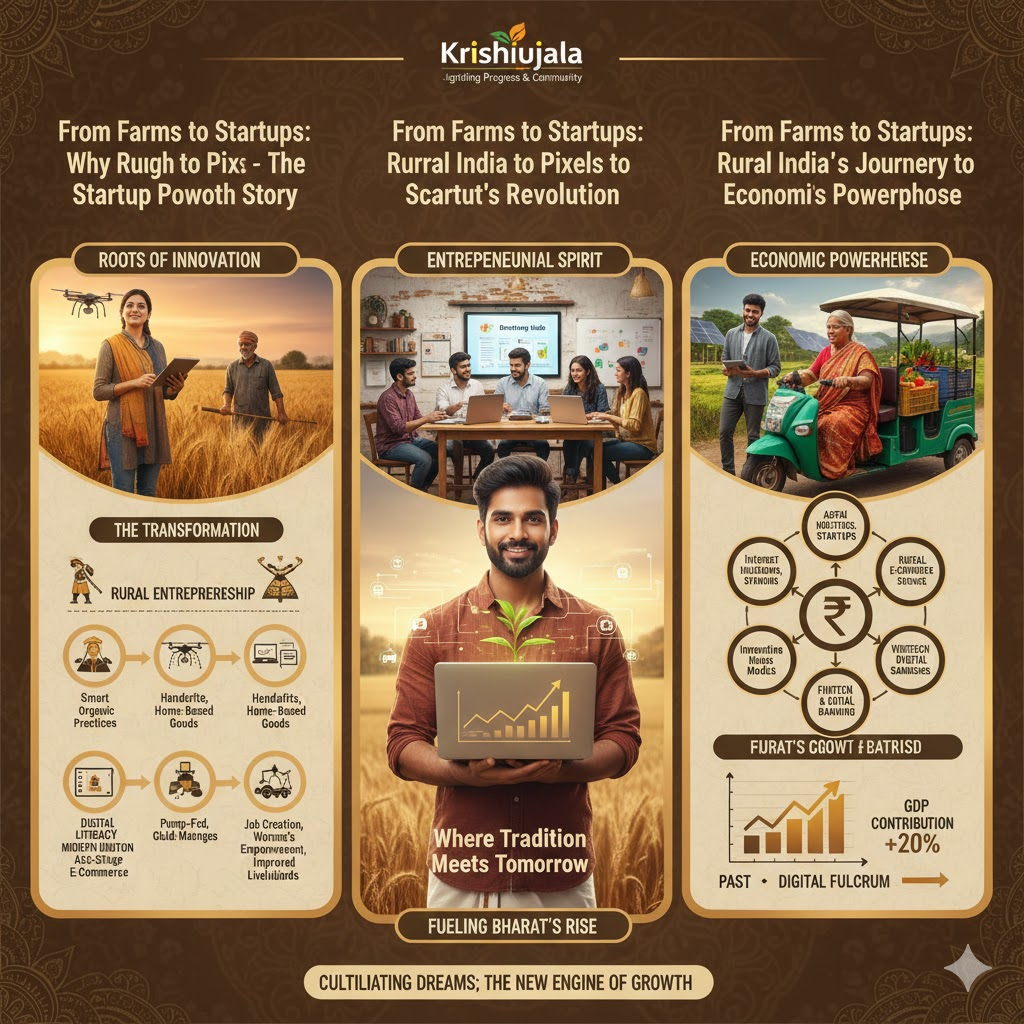
Rural India: The Unsung Growth Engine of Bharat
Rural India — often depicted through images of mustard fields, morning fog, and winding village lanes — is no longer just a backdrop to Bharat’s economic story. It has quietly emerged as a powerful engine of growth, driving change in ways that challenge long-held assumptions about development and modernity. Today, the narrative has shifted: rural India is not waiting for growth to reach it; it is creating growth from within.
At first glance, rural India’s demographic and economic profile may seem traditional: agriculture still dominates, and small towns and villages shape the daily realities of nearly two-thirds of the population. But beneath this familiar surface, a transformation is underway — one that blends tradition with innovation, sustainability with enterprise, and community values with entrepreneurial energy.
The Changing Face of Rural Economies
For decades, the rural economy was synonymous with agriculture. True, farming remains central — it is the lifeline not just of producers but of entire supply chains feeding into urban markets and export corridors. However, the rural economic tapestry is rapidly diversifying.
Today’s village is home to:
- Micro-enterprises producing everything from organic honey to hand-woven textiles.
- Agri-startups harnessing technology to reduce middlemen and ensure better price realization for farmers.
- Digital artisans selling crafts online and reaching customers far beyond local boundaries.
The impact is visible: incomes are rising, local markets are expanding, and new jobs are being created outside traditional agriculture. This shift helps stem urban migration, giving young people reasons to build livelihoods where they grew up.
Technology: Rural’s Invisible Catalyst
One of the most significant changes in rural India has been the rapid penetration of technology. Affordable smartphones, expanding internet connectivity under programs like Digital India, and the spread of digital payment systems have altered how rural citizens transact, communicate, and learn.
Farmers are no longer dependent solely on local mandis or brokers. With a few taps on their phones, they can:
- Check real-time market prices.
- Access weather updates and agronomy advice.
- Seek credit and insurance products designed for their needs.
E-commerce platforms have also opened new avenues for rural producers. A hand-loom saree from Varanasi, Amla candy from Madhya Pradesh, or bamboo goods from Assam — all now find customers online, with logistics networks delivering these products nationwide and globally. This has helped democratise opportunity and amplify rural voices in India’s economic conversation.
Agriculture: Modernisation Without Losing Roots
While diversification is key, agriculture remains both a symbol and substance of rural growth. Yet, farming in Bharat is no longer what it used to be.
Mechanisation, drip irrigation, precision farming, soil health cards, and improved seeds have boosted productivity. Government schemes like the PM-Kisan Samman Nidhi provide direct income support, and crop insurance schemes give farmers a safety net against unpredictable weather — something increasingly valuable in the era of climate change.
What’s equally striking is the growth of value addition in agriculture. Villages are hosting units for processing fruits, spices, dairy products, and more — converting raw produce into packaged goods that command higher prices. This not only increases farmers’ earnings but also creates local jobs. It is rural India transforming agricultural potential into economic reality.
Human Capital: Education and Skills in Motion
A growth engine is strong when its people are skilled, informed, and ready for opportunity. In recent years, rural India has experienced remarkable progress in education and skill development:
- Schools and colleges in smaller towns are expanding rapidly.
- Digital learning platforms are reaching households that once had limited access to books and teachers.
- Skill training programs aligned with market needs help youth prepare for jobs in both rural and urban contexts.
This shift in human capital is subtle but powerful. A generation that once saw its future only in cities now visualises success in villages too — as agripreneurs, educators, technicians, and local service providers.
Infrastructure: Bridging Distances, Bridging Dreams
Infrastructure development has been a cornerstone of rural transformation. Roads are connecting villages to markets; electricity ensures lights stay on for households and enterprises; clean water and sanitation improve health outcomes; broadband connects minds to ideas across continents.
These aren’t just steel and concrete achievements — they are bridges to possibility. A student in a remote village can now attend an online lecture. A farmer can watch an expert explain new techniques. A woman entrepreneur can accept digital payments.
With infrastructure improving quality of life, rural citizens are better positioned to participate fully in the national economy.
Beyond Economics: Changing Mindsets
Perhaps the most significant shift is not in statistics, but in mindsets. Rural India is shedding stereotypes of passivity and waiting for hand-outs. Instead, it is embracing agency, innovation, and self-determination. Youth are launching ventures; women are leading self-help groups and micro-enterprises; communities are organising collective solutions for local challenges.
This sense of ownership transforms growth from something that happens to rural India into something rural India drives.
A Growth Engine Roaring to Life
Today, the story of rural India is one of potential realised and potential unleashed. It is the drumbeat of tractors and digital notifications; of school bells and village assemblies; of crafts stitched with age-old techniques reaching global customers.
Rural India is more than an economic segment — it is a dynamic, evolving growth engine, powering Bharat’s next chapter. And as infrastructure, technology, education, and enterprise continue to converge, this engine will not just hum — it will roar.
Author

Rajat Joshi is a postgraduate scholar in Agricultural Extension and Communication, with a strong academic background in rural development, farmer communication, and agricultural innovation systems. He has a keen interest in agriculture journalism, focusing on translating research, policies, and field-level innovations into clear, impactful stories for farmers, students, and stakeholders. Rajat is passionate about strengthening the bridge between science and society through credible agri-media, awareness-driven reporting, and knowledge dissemination for sustainable agriculture.


2 thoughts on “From Farms to Startups: Why Rural India Is Powering Bharat’s Growth Story”