
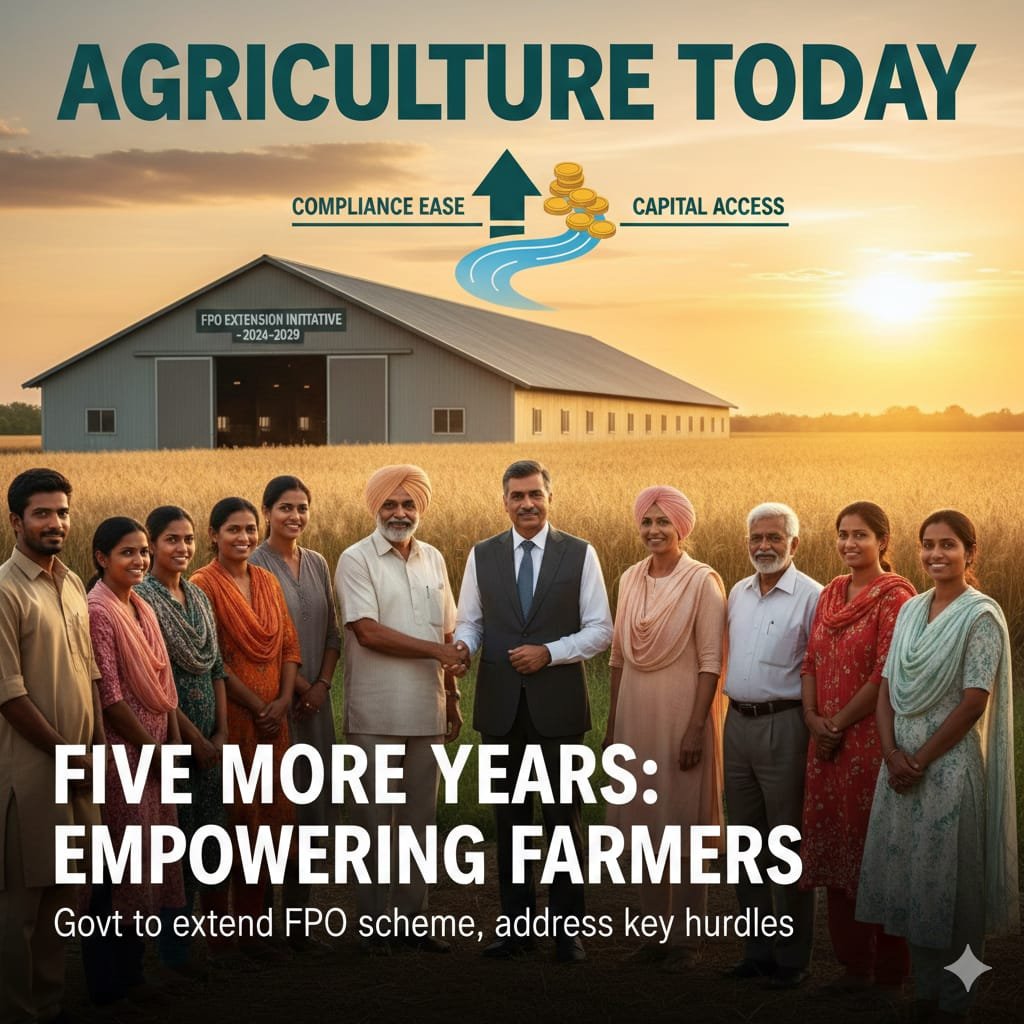
India’s agricultural future increasingly depends on collective strength rather than individual struggle. Recognising this, the Government of India has decided to extend the Farmer Producer Organisation (FPO) scheme for another five years, aiming to resolve long-standing issues of finance, compliance, and sustainability faced by farmer collectives across the country.
What is the FPO Scheme?
A Farmer Producer Organisation (FPO) is a collective of farmers, registered as a company or cooperative, that works to improve members’ access to inputs, technology, credit, processing facilities, and markets. The Central Sector Scheme for Formation and Promotion of 10,000 FPOs, launched in 2020, was designed to empower small and marginal farmers by enabling them to operate as organised business entities.
Under this scheme, FPOs receive financial assistance, professional handholding, and capacity building support during their initial years.
Why Was an Extension Needed?
Although nearly 10,000 FPOs have been formed, many of them remain fragile. Several FPOs struggle to survive beyond the early years due to:
- Limited working capital
- Difficulty in accessing bank credit
- High compliance costs under the Companies Act
- Lack of managerial and marketing expertise
The government’s decision to extend the scheme for five more years (2026–2031) reflects an understanding that farmer collectives need longer-term support to become economically viable and self-sustaining.
Key Improvements Proposed Under the Extended Scheme
1. Easier Access to Capital
One of the biggest challenges for FPOs is insufficient capital. The government is considering:
- Increasing the equity grant limit
- Introducing credit guarantee mechanisms
- Improving access to working capital loans
These measures will allow FPOs to invest in aggregation, storage, processing, and value addition.
2. Reduced Compliance Burden
Many FPOs find regulatory requirements complex and costly. To address this:
- The government is exploring relaxed penalties for new FPOs
- Support through professional service panels (accountants, company secretaries) is being discussed
- Emphasis is being placed on enabling farmers to focus on business rather than paperwork
3. Stronger Handholding and Capacity Building
The extended scheme will reinforce training in:
- Business planning and governance
- Market linkages and branding
- Quality control and export standards
This approach aims to transform FPOs from basic farmer groups into competitive agribusiness entities.
How Does This Benefit Farmers?
The extension of the FPO scheme has direct and indirect benefits for farmers:
- Better prices through collective bargaining
- Lower input costs via bulk purchasing
- Market access beyond local mandis
- Opportunities in processing and value addition
- Increased income stability and reduced dependence on middlemen
For small and marginal farmers, FPOs act as a bridge between traditional farming and modern agri-markets.
A Step Towards Sustainable Agriculture
FPOs play a crucial role in promoting crop diversification, value-added agriculture, and rural entrepreneurship. With continued government backing, these organisations can contribute significantly to doubling farmers’ income, improving rural employment, and strengthening India’s agri-value chains.
Conclusion
The extension of the FPO scheme is more than a policy decision—it is an acknowledgment that collective farming is essential for India’s agricultural resilience. By addressing capital shortages and compliance challenges, the government is laying the foundation for stronger, farmer-led institutions capable of shaping a more inclusive and profitable agricultural economy.
Author

One thought on “Strengthening Farmers’ Collectives: Government Extends FPO Scheme for Five More Years”