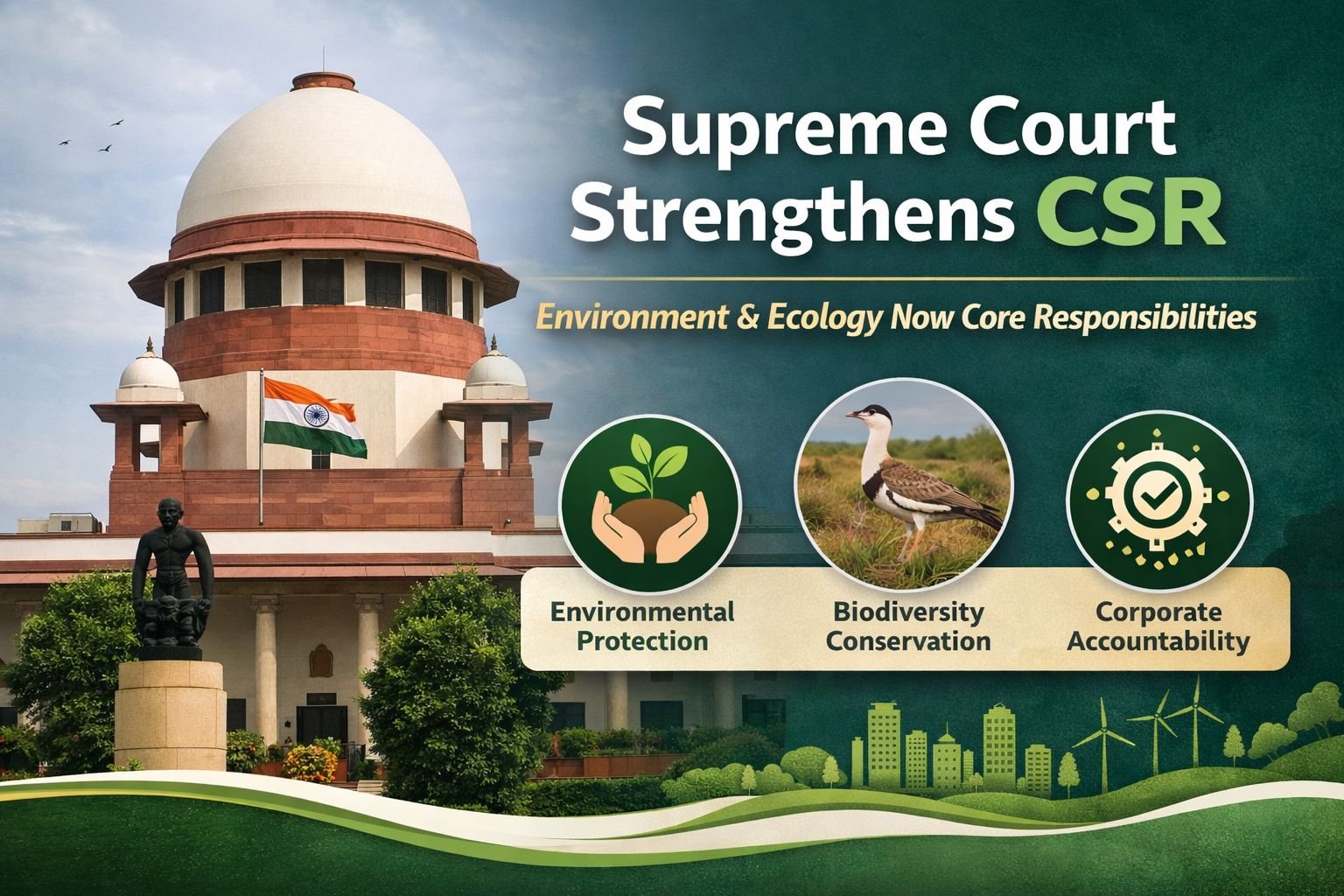
New Delhi: In a landmark judgment, the Hon’ble Supreme Court of India has significantly reshaped the understanding of Corporate Social Responsibility (CSR) by affirming that environmental and ecological responsibilities are intrinsic to it. The ruling elevates CSR from discretionary philanthropy to a domain of constitutional and strategic accountability, sending a clear signal to corporate India.
The Court’s observations underscore that environmental conservation is not optional, ecology cannot be an afterthought in business decisions, and corporate responsibility must align with the principles of sustainable development. By doing so, the judgment reinforces the idea that businesses are key stakeholders in protecting natural resources and ecological balance.
Implications for CSR Policy
The ruling is expected to influence CSR policies across sectors. Companies will need to prioritise environmental protection, biodiversity conservation, and climate action alongside social welfare initiatives. Token projects and cheque-book philanthropy are likely to fall short, with greater emphasis placed on measurable impact, scientific grounding, and long-term sustainability outcomes.
Impact on Corporate Strategy
Beyond compliance, the judgment will shape corporate strategy at the highest levels. Sustainability will increasingly be embedded into core business operations rather than confined to CSR departments. Environmental risk management, resource efficiency, and biodiversity protection are set to become board-level considerations, aligning CSR more closely with ESG frameworks that influence investment decisions and enterprise risk management.
Legal experts and sustainability professionals view the judgment as a judicial reinforcement of corporate accountability and a catalyst for more responsible, future-ready businesses in India. It presents an opportunity for organisations to design meaningful, high-impact interventions that protect ecosystems while creating long-term value.
The verdict marks a decisive shift—from merely “doing good” to doing what is right, necessary, and sustainable for the nation’s future.
Author

Gagan Tripathi is an agripreneur, plant scientist, and author known for his work in agritech innovation and sustainable horticulture. He is the Co-founder and CEO of Plant Orbit, a horticulture-focused startup dedicated to making healthy, scientifically managed plants accessible to urban and institutional consumers. Born in 2000, Gagan holds a master’s degree in Agriculture Extension and Communication, blending agricultural science with entrepreneurship and community outreach. He is also the author of the bestseller “Roadmap to Your Healthy Succulents”. His work focuses on sustainable plant care, green entrepreneurship, and building impact-driven agri startups in India.