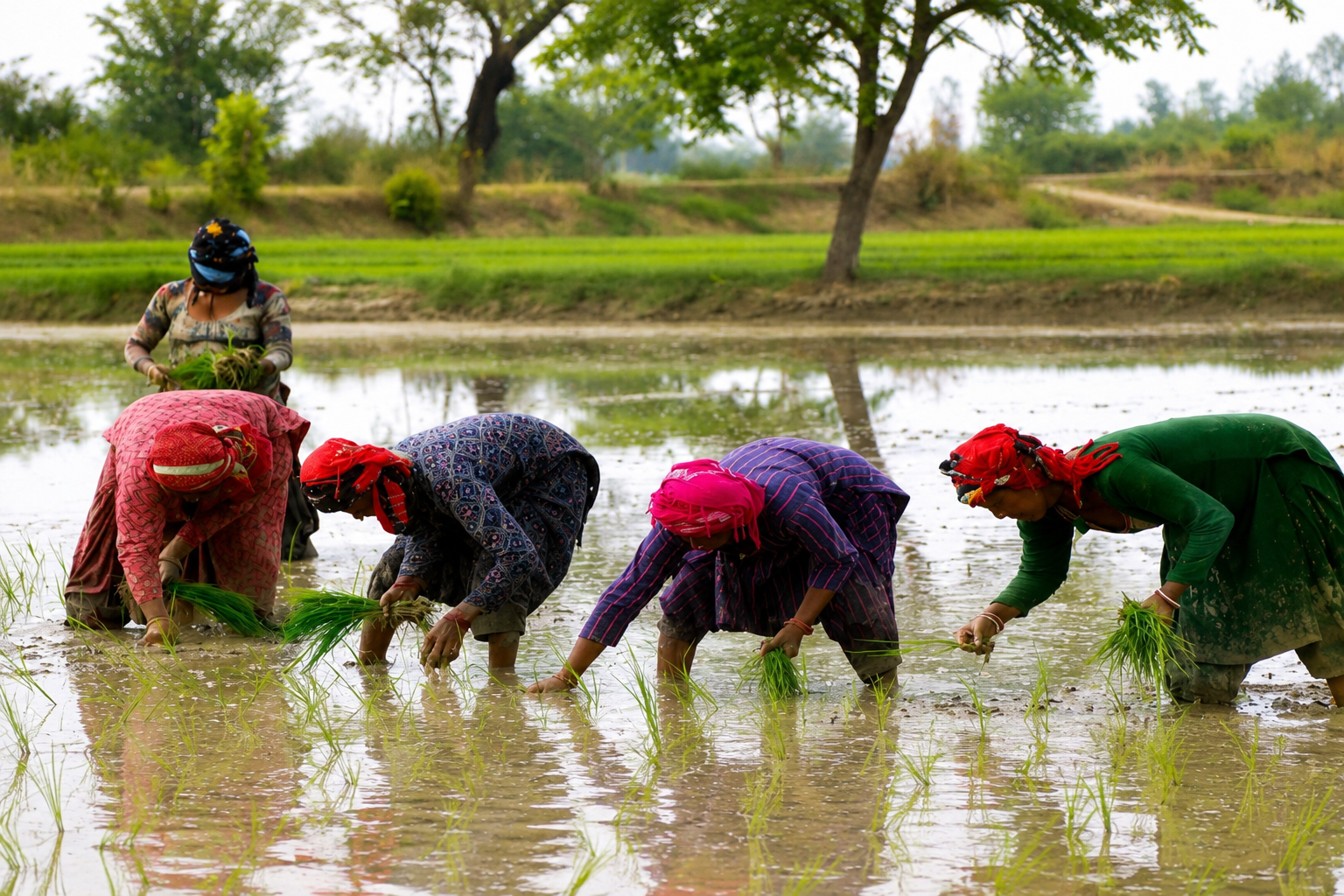
India, a nation whose heart still beats in soil even after years of technological advancement, agriculture is its spine holding upright the weight of 1.48 billion dreams. It fills the nation’s plate and fuels its workforce, each crop planted carries two promises: a harvest to feed a family and a wage to sustain a household. For years the soil never laid off its people hence, agriculture remains the nation’s largest private employer and ultimate safety net to country’s population.In this land built on agriculture the word ‘farmer’ arrives already dressed, a man, a plough in hand, a bullock cart behind him, an image so fixed that eight decades after independence, women sowing, weeding, picking, tending livestock and storing grain have never once altered it. The agrarian vocabulary has always had two separate words for the same work by a male and female. A man who ploughs, sows, and harvests is called a farmer, his labour has a title, a legal identity, sometimes even land in his name. While a single word “helper” carries the weight of everything she is denied. It denies her a wage for the days she spends sowing and weeding beside him. It denies her a name in the land records, even when she has worked on that land longer than he has. And in the unspoken order of the field, it denies her a place beside him, she is expected to walk a step behind, in labour as much as in status.
The Agriculture Census 2015-16 records women as 73% of India’s rural agricultural workforce, yet only 13.9% of them are landholders, a gap the government’s own data has documented, and never closed. Ownership of land was never the demand but equality never approached her thoughts. In most rural households, the field is where the day’s labour is meant to end, men return from it to eat, to rest, to sit. She returns not to rest but to a second life: homework to supervise, another meal to cook, a home to clean, children or elders to look after. Each task alone would count as a full day’s labour. For her, they are simply what a day requires.In Haryana, a study of women farm workers found that 87.5% suffered from drudgeries and lower back pain, most of it from carrying loads of 20 to 40 kilograms, water, fodder and grain often balanced on the head, nationally the picture is no different, nearly seven in ten women working India’s fields live with chronic musculoskeletal pain backs bent too often, shoulders strained under loads.
Inclusion vs. Authority
Despite performing the overwhelming share of farm labour, women remain absent from decisions about what to grow, when to sell, and how the income from their own work is spent. Authority here is not distributed by skill or effort; it is distributed by land title, and land titles rarely carry a woman’s name. Even in households where she manages the farm entirely through a husband’s migration, illness, or absence, the final word on selling, borrowing, or spending still depend upon other men of family.
The path forward
To leave women unrecognized in agriculture is not just a social injustice, it is an economic mistake. India suffers from a lack of women in the decisions. For generations, female farmers have carried the physical weight of food security while remaining legally and culturally shadowed as mere ‘subordinates.’ True progress will not come from simply praising their endurance or documenting their injuries. It will come when a woman holding a sick sickle is imagined the same way a male farmer is pictured.
Refrences
Government of India, Ministry of Agriculture & Farmers Welfare, All India Report on Agriculture Census 2015–16, Agriculture Census Division, 2020, agcensus.nic.in.
Suthar, N., and Kaushik, V., “Assessment of manual load carrying and health status of women farm workers of district Sonipat (Haryana), India,” Journal of Applied and Natural Science.
Author

Sakshi Kulshrestha, an Agricultural University student from Gujarat. Have keen interest in public welfare as well as human psychology. National debater and have served as intern under Ministry of Women and Child Development, GOI.