
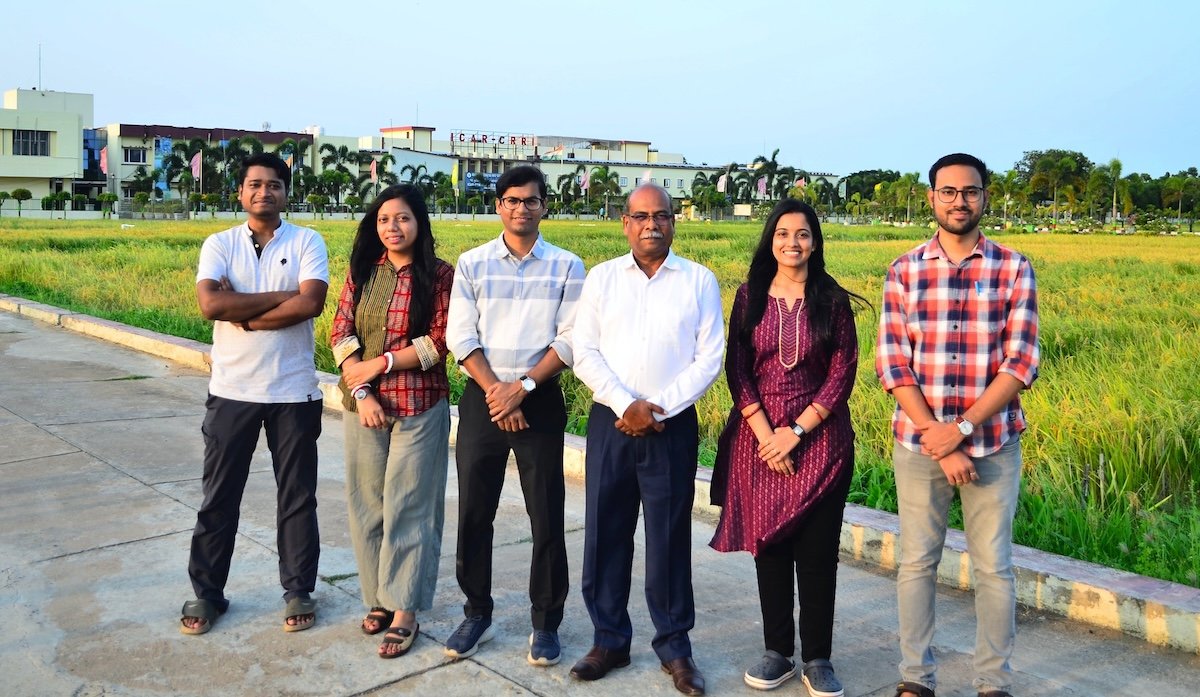
Plant-OpenCRISPR-1 (POC1) is the world’s first AI based genome editing platform developed by ICAR-CRRI which was led by Dr. Qutubuddin Ali Molla (other members include Priya Das, Romio Saha, Debasmita Panda, Chandana Ghosh, S P Avinash, Sonali Panda, Mirza Baig). This is an advanced technology which surpasses the limitations and challenges of traditional CRISPR techniques relying on bacterial enzymes like Cas9 and Cas12a. POC1 utilizes AI designed enzymes enabling it to perform gene knockout, gene editing and prime editing in crops. The researchers demonstrated that an AI-designed enzyme can efficiently perform gene disruption and modify DNA letters at single-base resolution in a crop plant, using rice as the model system
Genome editing functions like a molecular scissor, enabling scientists to precisely alter a plant’s DNA to develop improved varieties without permanently introducing foreign genes. Until now, plant genome-editing tools have depended on proteins derived from bacteria and other naturally occurring microbes. The ICAR team’s work demonstrates that AI-designed enzymes can function robustly inside plant cells a capability not previously reported in plant systems.
Genome editing has emerged as one of the most transformative biotechnological tools for modern agriculture, which enable precise crop improvement with unprecedented speed and accuracy. However, all currently available plant genome editing systems are derived from naturally occurring bacterial or archaeal proteins. In addition, the two most widely used genome editing platforms, Cas9 and Cas12, are protected by complex intellectual property frameworks, limiting their global accessibility and commercial deployment in some regions.
OpenCRISPR-1 (OC1) which differs from prototypical SpCas by more than 400 amino acids has shown promise in human cells. Das and colleagues took the bold next step of testing it in rice, through a system they refer to as Plant OpenCRISPR-1 (POC1). Their first experiment used rice protoplasts to create double-strand breaks at four target loci, with editing efficiencies ranging from 10.0% to 16.8%. These results were not significantly different from those of conventional SpCas9, suggesting that POC1 can perform comparably in plants. The authors then expanded the study to more precise editing modes. Base editing was used to induce specific single-base conversion, while prime editing allowed targeted sequence rewriting from an RNA template. They also assessed biallelic editing, where more than one gene is modified. In each case, POC1 could perform the edits, and its performance remained broadly comparable to that of established methods. Overall, the study shows that an AI-designed editor can function effectively in a crop species, opening the door to more flexible and potentially more powerful genome-editing tools for future plant improvement.
Researchers from the ICAR-Central Rice Research Institute developed and experimentally validated Plant OpenCRISPR-1 (POC1), an artificial intelligence-designed genome editing nuclease tailored for plant systems. The study has been published in New Phytologist. Built upon the OpenCRISPR-1 platform, POC1 represents one of the first AI-designed genome editing systems for crop improvement and commercial applications.
Alongside gene disruption, POC1 can efficiently induce precise point mutations through base editing and prime editing approaches. The researchers demonstrated that POC1-mediated knockout, adenine base editing, cytosine base editing, and prime editing exhibit efficiencies comparable to those of the conventional SpCas9 system while recognizing the same NGG PAM sequence. Stable transformation and validation in regenerated rice plants further confirmed its practical applicability in crops. The study highlights how AI-designed proteins could transform agricultural biotechnology, particularly for the Global South, by potentially improving the accessibility and affordability of genome editing technologies through reduced intellectual property constraints, without compromising editing efficiency.
Since OpenCRISPR-1 was released as an open-source nuclease and is proposed to be freely available for academic research and commercial licensing, it has the potential to broaden access to genome-editing technologies and represents an attractive alternative to SpCas9.
This research was supported by funding from Indian Council of Agricultural Research (ICAR). The work reflects India’s developing capabilities at the intersection of artificial intelligence, genome editing, biotechnology, and agricultural science, and holds promise for advancing the nation’s food security goals.
Author

Nishant Sidnal is a postgraduate student pursuing a Master’s degree in Genetics and Plant Breeding at Anand Agricultural University, Gujarat. Driven by curiosity and a passion for research, he enjoys exploring new concepts and translating theoretical knowledge into practical applications.