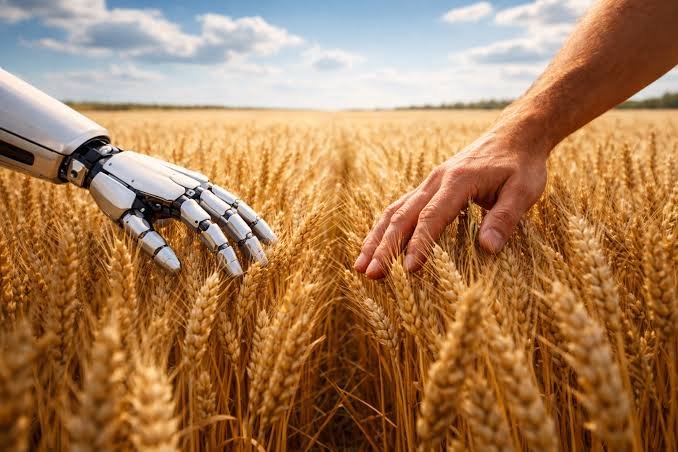
Agriculture has been a humanity’s enterprise for over 10,000 years, helping transform nomadic societies into civilizations. Yet, despite improvement farming remains reactive, subject to unpredictable weather, pest pressures, soil degradation and resource scarcity forcing farmers to make critical decisions based on limited information. Currently with global populations exceeding 8 billion and shrinking land area, we face a paradox, we must produce more food with fewer resources while simultaneously regenerating exhausted soils and ameliorating degraded environments. In response to these hindrances, modern artificial intelligence technologies haveappeared as a game-changer, revolutionizing agriculture and offering innovative solutions to age-old problems. In recent years, the agricultural sector has witnessed a remarkable transformation with the integration of modern AI technologies.
WHAT IS AI?
Artificial Intelligence (AI) is the ability of machines to perform tasks that normally require human intelligence. It enables systems to learn from experience, adapt to new situations and solve complex problems independently. AI uses datasets, algorithms and large language models to analyze information, recognise patterns and generate responses. Over time these systems improve their performance, allowing them to reason, make decisions and communicate in ways similar to humans.
AI IN AGRICULTURE USES
In agriculture, AI helps turn data into simple, actionable advice that farmers can implement in their day-to-day farming practices. By analysing satellite imagery, weather forecasts, soil data, and crop patterns, AI can help farmers decide what to sow, when to sow, how much input to use, and when to harvest. From early warnings about pests and diseases to better planning for irrigation and fertiliser use, AI is making farming more precise, efficient, and less risky. The uses of AI in agriculture can be categorised as:
• Soil Health Diagnostics
AI uses deep learning and image recognition to monitor soil health by analysing signals from satellite imagery, drone-based observations, and farm-level images. This eliminates the need for laboratory testing infrastructure while detecting nutrient deficiencies and soil stress. Farmers can take timely action to restore soil fertility.
• Climate-Responsive Crop Monitoring and Advisory Services
Indian agriculture is particularly susceptible to climate variability because it relies heavily on rainfall. AI analyses weather and climate data to predict changing rainfall patterns, temperature variations, and extreme events, while providing real-time advisories on sowing decisions, irrigation scheduling, pest management, and input application. In addition, AI-enabled monitoring using satellite imagery, drones, sensors, and image analytics facilitates early detection of pests and crop diseases, allowing timely interventions. Collectively, these applications support farmers, particularly in rainfed regions, in managing climate risks and reducing potential crop losses.
• Improving Farm Mechanisation Efficiency
AI-powered image classification and machine learning tools, integrated with drones, remote sensing, and local sensor data, improve the utilisation and efficiency of farm machinery. Applications include precision weed removal, early disease detection, automated harvesting, and produce grading.
In horticulture, where crops require continuous monitoring across multiple growth stages, AI-based systems offer round-the-clock surveillance of high-value crops. This leads to reduced labour dependency, optimised input use, and improved quality control.
• Improving Price Realisation for Farmers
Farmers, particularly those engaged in fruit and vegetable production, often capture only a small share of the final consumer price due to inadequate price discovery, supply chain inefficiencies, and information asymmetries. Artificial intelligence (AI) offers a robust means of addressing these structural constraints by strengthening demand-supply forecasting, market intelligence, and coordination across agricultural value chains.
AI-driven predictive analytics leverage large datasets from platforms such as e-NAM, AGMARKET, the Agricultural Census, and the Soil Health Card programme to assess price movements, arrival trends, and regional demand patterns. By incorporating both domestic and global commodity signals, these tools support more informed decisions on crop selection, sales timing, and market choice, thereby enhancing price realisation and reducing distress-driven sales. The implementation of AI in agriculture highlights the breadth of bottom-up adoption across the sector. AI-enabled agricultural networks have improved market access, price discovery, and logistical efficiency for about 1.8 million farmers across 12 states.
AI ADVISORY FOR FARMERS
Kisan e-Mitra:
Kisan e-Mitra, launched in 2023, is a voice-enabled, AI-powered chatbot designed to support farmers by answering queries on key government schemes, including PM Kisan Samman Nidhi, the Kisan Credit Card, and the Pradhan Mantri Fasal Bima Yojana. The platform operates in 11 regional languages and currently addresses over 8,000 farmer queries each day. As of December 2025, it has successfully responded to more than 93 lakh queries, enhancing accessibility to scheme-related information for farmers across the country.
National Pest Surveillance System:
The National Pest Surveillance System (NPSS), launched in 2024, utilises Artificial Intelligence (AI) and Machine Learning (ML) to enable early detection of pest infestations and crop diseases. Accessible through a user-friendly mobile application and the online portal, the system allows farmers to upload images of affected crops or pests for rapid identification and diagnosis.
Using image analytics, NPSS provides real-time crop protection advisories, guiding farmers on appropriate pest and disease management practices and enabling timely interventions to reduce crop losses. As of December 2025, NPSS is being used by over 10,000 extension workers and supports 66 crops and more than 432 pest species.
AI-Enabled Local Monsoon Onset Forecasts for Informed Kharif Sowing Decisions:
An AI-based pilot was implemented during Kharif 2025 to generate location-specific monsoon onset forecasts across parts of 13 states. The initiative was carried out in collaboration with the India Meteorological Department (IMD) and the Development Innovation Lab-India. The pilot employed an open-source blended modelling approach, combining NeuralGCM, the European Centre for Medium-Range Weather Forecasts’ (ECMWF) Artificial Intelligence Forecasting System (AIFS), and 125 years of historical rainfall data from IMD. To guide optimal sowing decisions, focusing on local monsoon onset, probabilistic forecasts were disseminated via SMS through the mKisan portal to over 3.88 crore farmers in five regional languages across 13 states. Follow-up surveys in Madhya Pradesh and Bihar indicated that 31–52 percent of farmers modified their planting decisions based on the forecasts, primarily by adjusting land preparation, sowing timelines, and crop and input choices.
CONCLUSION
India is undergoing a profound technological transformation in agriculture, leveraging Artificial Intelligence to move from traditional methods to a data-driven, precision-based ecosystem. This shift is anchored by the creation of a massive digital public infrastructure, including the Digital Agriculture Mission and AgriStack, which provides a verified foundation for delivering targeted services to millions of farmers. The integration of AI is delivering tangible benefits across the entire agricultural value chain.
Author

Nishant Sidnal is a postgraduate student pursuing a Master’s degree in Genetics and Plant Breeding at Anand Agricultural University, Gujarat. Driven by curiosity and a passion for research, he enjoys exploring new concepts and translating theoretical knowledge into practical applications.