Megha M S¹, Akhil S². ¹Department of Genetics and Plant Breeding, Centre for Plant Breeding and Genetics, Tamil Nadu Agricultural University, Coimbatore 641 003, Tamil Nadu, India ²Department of Agricultural Microbiology, B. A. College of Agriculture, Anand Agricultural University, Gujarat- 388110, India
Introduction
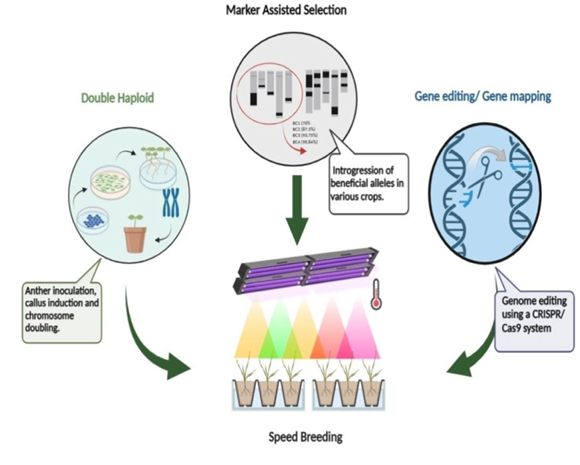
Developing a new crop variety is rarely a quick job. A breeder may spend several years crossing plants, advancing generations, selecting promising individuals and testing them under different environments before a variety is ready for farmers. While this careful process remains essential, agriculture is facing problems that cannot always wait for a decade. New pests and diseases appear, weather patterns are changing and farmers need varieties that can cope with drought, heat, salinity and other stresses.This is where speed breeding has brought a different approach to crop improvement. Instead of waiting for the natural growing season to complete one generation, breeders manipulate the growing environment to encourage plants to flower and produce seed much earlier. Carefully managed light, temperature and other conditions can shorten the time between generations, allowing breeders to advance their populations much faster than under conventional conditions (Watson et al., 2018).The idea is simple, but its implications are considerable. Speed breeding does not replace conventional breeding. Instead, it gives breeders something extremely valuable: time. When combined with marker assisted selection, doubled haploid production, genomic tools and gene editing, it can help move useful traits through a breeding programme much more rapidly. (Nature)
The Problem With Waiting for the Next Generation
A breeder cannot select the best plants from a generation until that generation has been produced. After making a cross, the resulting plants have to grow, flower and produce seed before the next generation can begin. In crops with long generation times, this waiting period can become one of the biggest bottlenecks in breeding.Traditionally, breeders have tried to overcome this problem through off season nurseries, multiple locations and other methods of advancing generations. These approaches have helped, but they still depend heavily on climate and growing seasons.Speed breeding changes the situation by bringing much of the plant’s growth cycle under controlled conditions. Extended light periods, suitable temperatures and carefully managed crop growth can encourage earlier flowering and seed production. In the original speed breeding experiments, researchers achieved up to six generations per year in crops such as wheat, barley, chickpea and pea, compared with about two to three generations under normal glasshouse conditions (Watson et al., 2018). (Nature). For a breeder, that difference is significant. A year that once allowed only one or two generations can potentially provide several opportunities for selection.
What Happens Inside a Speed Breeding Facility?
A speed breeding facility may look very different from an ordinary crop field. Plants are grown under carefully controlled conditions where light and temperature can be adjusted according to the needs of the crop. Light is particularly important. Many crops respond to the length of the day, and providing longer periods of light can encourage faster development and earlier flowering in suitable species. LED lighting has become useful because it can provide controlled light efficiently while allowing researchers to adjust the growing environment (Ghosh et al., 2018). The plants are also grown at suitable temperatures and densities. Once they flower and produce mature enough seed, the next generation can be started without waiting for the normal field season to arrive. The exact conditions are not the same for every crop. Wheat and barley may respond well to particular long day conditions, while crops with strong photoperiod or vernalisation requirements need specially designed protocols. This means speed breeding is not simply a matter of placing plants under bright lights. The environment has to be matched carefully with the biology of the crop and sometimes with the genotype itself (Ghosh et al., 2018). (Nature)
Speed Alone Is Not the Whole Story
The real strength of speed breeding becomes clearer when it is combined with other breeding technologies. Consider a simple breeding programme. A breeder makes a cross between two parents to combine useful traits. Instead of advancing each generation slowly under normal conditions, speed breeding can be used to produce the next generation more quickly. Molecular markers can then help identify plants carrying the desired genes. Doubled haploid methods can speed up the production of genetically fixed lines, while other genomic tools can assist in selecting the most promising material. The technologies do not perform the same job. Speed breeding mainly reduces the time between generations, while molecular breeding tools help breeders decide which plants are worth carrying forward. Their combination is what makes the breeding pipeline more efficient.
From the Growth Chamber to the Farmer’s Field
An important point is sometimes missed when speed breeding is discussed. A plant that performs well inside a controlled facility is not automatically a successful variety. Field conditions are much less predictable. Temperature fluctuates, rainfall is uneven, soils differ and plants encounter pests, diseases and competition. A trait selected under controlled conditions must eventually be tested under the environments where farmers will grow the crop. This is why speed breeding should be viewed as a way of accelerating the early stages of breeding, rather than eliminating field evaluation. The faster generations produced inside a facility still need to move into field trials before a breeder can judge their yield, stability, adaptation and other important characteristics (Watson et al., 2018). This distinction is especially important for traits such as yield and drought tolerance, which are strongly influenced by the environment. Speed breeding can help breeders reach advanced generations faster, but the final decision still belongs to the field.
A Faster Future for Indian Crops
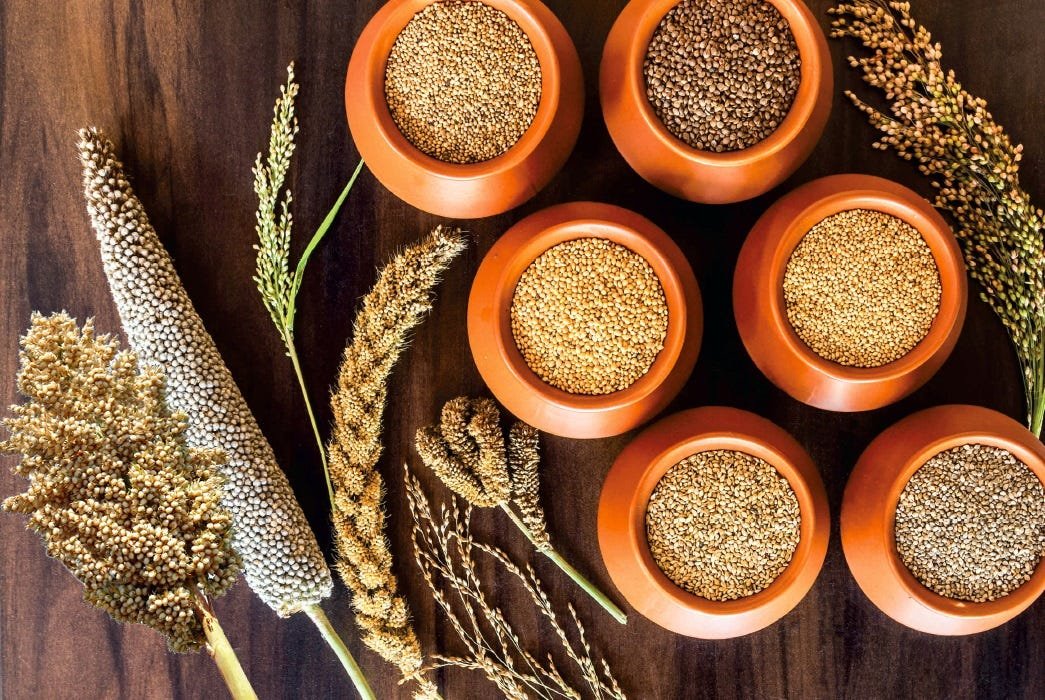
The idea of speed breeding is no longer restricted to wheat and other crops in which the technique was first demonstrated. Researchers are adapting it to crops that have traditionally been difficult to advance rapidly. Pigeonpea is a particularly interesting example for India. Its sensitivity to day length has traditionally limited generation advancement. Research at ICRISAT has developed speed breeding approaches that can produce several generations per year and has combined rapid generation advancement with seed or pod based genotyping (Gangashetty et al., 2024). Earlier work had also proposed speed breeding as a way of reducing the long breeding cycle of pigeonpea (Saxena et al., 2019). (Open Access Repository of ICRISAT) The work has now moved beyond the laboratory. In 2025, ICRISAT reported the development of ICPV 25444, a heat tolerant pigeonpea cultivar developed using its speed breeding programme. The cultivar matures in about 125 days and has been tested under high temperature conditions in several Indian states. ICRISAT reported that its pigeonpea speed breeding protocol allowed up to four generations per year and helped reduce the estimated breeding timeline considerably. (ICRISAT)Another recent development is the introduction of a speed breeding protocol for finger millet by ICRISAT, reported in 2025. The protocol allows up to four to five generations in a year, compared with one or two under conventional field conditions. Such developments are particularly relevant for crops important to smallholder farmers and nutrition programmes. (ICRISAT) These examples show why speed breeding deserves attention in Indian crop improvement. The goal is not simply to make plants grow faster. It is to make the breeding process itself move faster.
Limitations?
Speed comes with its own challenges. Controlled facilities require infrastructure, electricity, skilled management and regular monitoring. Extended lighting and climate control can increase operating costs, although improvements in LED technology and facility design can help reduce energy use. Not every crop or genotype responds equally well to speed breeding. Crops with strong photoperiod sensitivity or special temperature requirements may need customised protocols. Even within a crop, different varieties can respond differently to the same conditions. There is also the question of scale. Producing a few generations in a research facility is one thing; managing thousands of breeding plants efficiently is another. Seed handling, pollination, selection and record keeping all become important when generations are moving rapidly. For these reasons, speed breeding should be considered a tool within a breeding programme, not a replacement for the breeder’s judgement or field testing.
The Race Against Time
Agriculture has always been a race against time. Farmers have to respond to changing seasons, new pests, diseases and unpredictable weather. Plant breeders face a similar challenge, except their response often takes several years to reach the field. Speed breeding offers a way to shorten that waiting period. By allowing more generations to be produced in a year and working alongside marker assisted selection, doubled haploids and modern genomic technologies, it can help breeders move useful traits through breeding programmes more quickly. The greatest promise of speed breeding is therefore not simply faster plants. It is faster progress towards better varieties. As the technology becomes more accessible and is adapted to more crops, it could become an important part of developing varieties suited to the needs of tomorrow’s farmers.
References
1.Chaudhary, N., & Sandhu, R. (2024). A comprehensive review on speed breeding methods and applications. Euphytica, 220, 42. https://doi.org/10.1007/s10681-024-03300-
2.Ghosh, S., Watson, A., Gonzalez Navarro, O. E., Ramirez Gonzalez, R. H., Yaneske, E., Hickey, L. T., & Wulff, B. B. H. (2018). Speed breeding in growth chambers and glasshouses for crop breeding and model plant research. Nature Protocols, 13, 2944–2963. doi:10.1038/s41596-018-0072-z (Nature).
3.Gangashetty, P. I., Belliappa, S. H., Bomma, N., Kanuganahalli, V., Sajja, S. B., Choudhary, S., Ramanagouda, G., Bomireddy, D., Kumar, V. A., Pranati, J., Sharma, M., & Pandey, M. K. (2024). Optimizing speed breeding and seed/pod chip based genotyping techniques in pigeonpea: A way forward for high throughput line development. Plant Methods, 20, 1–12. (Open Access Repository of ICRISAT)
4.Saxena, K. B., Saxena, R. K., Hickey, L. T., & Varshney, R. K. (2019). Can a speed breeding approach accelerate genetic gain in pigeonpea? Euphytica, 215, 1–7. (Open Access Repository of ICRISAT)
5.Watson, A., Ghosh, S., Williams, M. J., Cuddy, W. S., Simmonds, J., Rey, M. D., Hatta, M. A. M., et al. (2018). Speed breeding is a powerful tool to accelerate crop research and breeding. Nature Plants, 4, 23–29. doi:10.1038/s41477-017-0083-8 (Nature)
6.International Crops Research Institute for the Semi Arid Tropics. (2025). Breakthrough at ICRISAT: World’s first extreme heat tolerant pigeonpea developed via speed breeding. (ICRISAT1
Authors


I am Megha M. S., an M.Sc. scholar in Genetics and Plant Breeding at Tamil Nadu Agricultural University, Coimbatore. I completed my B.Sc. (Hons.) Agriculture from Kerala Agricultural University, Vellayani. My interests are centered around plant breeding, genetics, crop improvement, and agricultural research. I am also keen on scientific writing, reviewing, and exploring how research can be communicated effectively to both academic and wider agricultural communities