Abstract
The modern agriculture faces twin challenge; feeding a growing population while conserving soil health, water and biodiversity. Excessive reliance on chemical fertilizers and pesticides has degraded soils, polluted water bodies and increased input costs for farmers. This results in residual effect, soil pollution and affect the overall soil productivity. Soil and plant-associated microbes such as diazotrophs, phosphate solubilizers, potassium mobilizers, mycorrhizal fungi, plant growth promoting rhizobacteria (PGPR) and biocontrol agents offer an eco-friendly alternative that improves nutrient availability, induces stress tolerance and suppresses plant pathogens. This article discusses the major groups of beneficial microbes, their mechanisms of action, their role building a sustainable and climate-resilient agricultural system.
Introduction
Agriculture today stands at a crossroads. The Green Revolution dramatically increased food grain production, but it also created heavy dependence on synthetic fertilizers and chemical pesticides. Continuous and imbalanced use of these inputs has led to declining soil organic carbon, disturbed soil microbial diversity, groundwater contamination with nitrates, greenhouse gas emissions and rising cultivation costs. At the same time, climate change is bringing more frequent droughts, floods, heat waves and new pest and disease outbreaks, putting additional pressure on crop productivity.
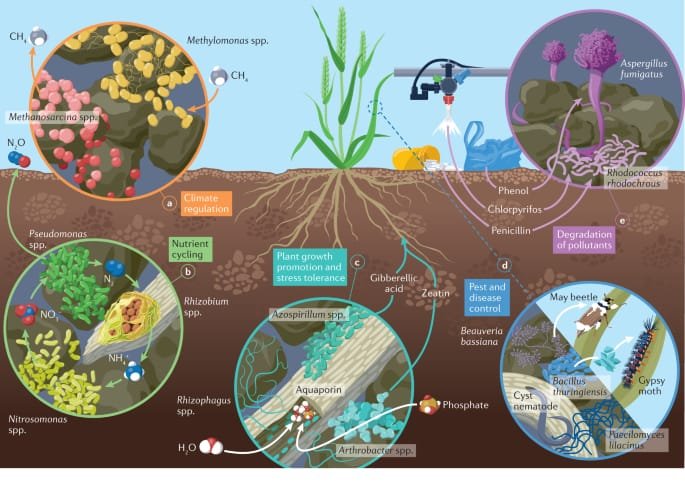
Every gram of fertile soil harbours billions of microorganisms belonging to thousands of species, forming an invisible workforce that has sustained plant life for millions of years long before synthetic fertilizers existed. Bacteria, fungi, actinomycetes and archaea living in the rhizosphere (the soil zone around plant roots) and even inside plant tissues as endophytes perform vital functions: they fix atmospheric nitrogen, solubilize locked-up phosphorus and potassium, produce plant growth hormones, protect roots from disease-causing organisms and help plants cope with drought, salinity and heat stress. Harnessing this natural potential through microbial inoculants, biofertilizers and biopesticides is now recognized as one of the most promising and economical routes towards sustainable, climate-resilient crop production.
Major Groups of Beneficial Microbes and Their Role
1. Nitrogen-fixing microbes: Nitrogen is required in the largest quantity by crops, yet the atmosphere’s abundant nitrogen gas cannot be used directly by plants. Some free-living or associative nitrogen fixers, like Azotobacter and Azospirillum species, fix nitrogen not only for plants like wheat, maize and rice but also for other free-living or associative nitrogen fixers. In addition, these microbes also produce growth-promoting substances for the mentioned plants.
2. Phosphate and potassium solubilizing microbes: Many soils contain large amounts of phosphorus and potassium as minerals which are not available to the plants. These soil microorganisms solubilize the minerals and convert them into forms which can be taken up by plants. These organisms can also solubilize potassium minerals in the soil thus providing an alternative to expensive potassic fertilizers. Some of the major organisms that solubilize these minerals are Bacillus, Pseudomonas, Aspergillus and Penicillium.
3. Arbuscular mycorrhizal fungi (AMF): Fungi that form associations with roots of plants. AMF increase the surface area of roots of plants to absorb water and nutrients such as P, Zn, Cu etc. The plant provides energy in the form of carbohydrates to AMF. Mycorrhized plants are more drought-tolerant, absorb more nutrients and are also more resistant to soil-borne pathogens.
4. Plant growth promoting rhizobacteria (PGPR): PGPR such as Pseudomonas fluorescens, Bacillus subtilis, Azospirillum species etc. promote plant growth by colonizing roots of plants. They also produce growth promoting substances like indole acetic acid (IAA). PGPR also protect the plants against pathogens by producing siderophores which are iron chelating agents and are not available to pathogens for their growth. The biocontrol agent PGPR also protects the plants against various stresses by producing 1-aminocyclopropane-1-carboxylate (ACC) deaminase which reduces the level of stress causing hormone ethylene in the plant. Plants can also be protected against various abiotic stresses like drought, salinity and flooding by using PGPR.
5. Biocontrol agents: The soil-living fungus Trichoderma, for example, attacks other soil fungi which can cause disease on plants, like Fusarium spp., Rhizoctonia spp. and Sclerotium spp. Also there are many microorganisms which are used as biopesticides against insect pests. Bacillus thuringiensis, for example, produces crystal proteins which are toxic for certain insects. Also there are microorganisms which induce a form of defense in plants, called ‘systemic resistance’. This resistance is, for example, induced by Pseudomonas fluorescens.
Mechanisms of Microbial Benefit to Crops
• Fixation of nitrogen as well as solubilization of nutrients to enhance the use efficiency of nutrients for crop growth and to reduce the requirement for fertilizers.
• Production of phytohormones (auxins, gibberellins, cytokinins etc.) that promote plant growth (e.g. promotion of root branching).
• Induced systemic resistance and antibiosis against pathogens, which results in a reduction of the use of chemical fungicides and a decrease in disease incidence.
• The beneficial microbes also alleviate stresses on plants like drought stress, salinity stress and heat stress. The ways through which beneficial microbes alleviate stresses include, ACC deaminase activity, osmolyte production and increased water use efficiency.
• Improved soil structure through growth of microbial biomass such as gums and aggregation in soil to sustain soil health for long.
Microbial Inputs in Sustainable Farming Systems
Biofertilizers such as nitrogen fixing bacteria, phosphorus- and potassium- solubilizing microorganisms and mycorrhizal fungi are used as seed treatment (soil, root dip and soil application) as part of an Integrated Nutrient Management (INM) system, using reduced amounts of chemical fertilizers. Biopesticides in the form of bioagents (Trichoderma, Pseudomonas and Bacillus species) are used as seed treatment (soil, root dip and soil application) in combination with minimum safe doses of conventional pesticides as part of an Integrated Pest Management (IPM) system. These are used by farmers to produce Vermicompost and Compost enriched with beneficial microorganisms, to improve soil organic carbon, structure, aggregation, and supply of nutrients to crops.
Benefits of Microbe-Based Technologies
• Cost-effective: Biofertilizers and biopesticides are considerably cheaper than chemical inputs for plant protection. Biofertilizers and biopesticides are easy to produce by farmers at village or district level with simple technology.
• Eco-friendly: These technologies are environmentally friendly, they reduce chemical runoff into water bodies, and also reduce the amount of Green House Gases that are emitted into the atmosphere as well as harmful pesticide residues in food.
• Structure of soil is improved by biofertilizers, they add to the organic matter of the soil, and they help in stabilizing the aggregates of soil for long term. They promote the growth of beneficial microorganisms of soil.
• Climatic resilience: Certain microorganisms help crops fight off stresses brought on by drought, salinity, heat and thus assist in enhancing crop’s ability to fight off adverse climatic conditions and ensure their growth.
• Farmer income: Biofertilizers help to keep down production costs, and this in turn can increase the farmer’s income due to higher and stable yields.
Challenges in Adoption
However, there are also several challenges associated with the practical implementation of these technologies. Most of the currently available carrier-based inoculums are of short shelf life and are very sensitive to temperature during storage. Even if the products are delivered to the farmers in good condition, the field performance may not be as expected. This is partly due to the differences in the native soil microbial communities as well as differences in soil pH, moisture and temperature. Many farmers are also unaware of the correct methods of application as well as the optimal time for application. In many situations, the use of beneficial microorganisms is incompatible with the use of pesticides. In many parts of the world, there is also a lack of quality control as well as lack of standardization between manufacturers. Therefore, the quality of products available in the market is very variable.
Future Prospects
Future advances in microbial genomics, next generation sequencing and synthetic biology are expected to allow the design of tailored microbial communities for individual crops, soils and climates. Improved encapsulation systems based on nanotechnology for beneficial microorganisms will increase their shelf life and field survival. The combination of beneficial microorganisms with precision agriculture (soil sensors, site specific application of nutrients) will allow for improved delivery and use of beneficial microorganisms. Several government programs aim to promote organic and natural farming. Consumer demand for chemical free food is increasing globally and will also drive the adoption of microbial technologies.
Conclusion
Beneficial microorganisms are Nature’s solutions to agricultural problems. These organisms can fix nitrogen, solubilize locked-up nutrients, promote plant growth and development, suppress plant pathogens, and help plants to resist stresses. The use of these beneficial organisms can help reduce farmers’ dependence on chemical fertilizers and pesticides, and protect soil and environment from adverse effects of these inputs. Awareness of these beneficial organisms, better formulation and delivery of these beneficial organisms, and supportive government policies are required to fully utilize their beneficial services for development of sustainable and climate change-resilient crop production systems.
References
Bhattacharyya, P. N., & Jha, D. K. (2012). Plant growth-promoting rhizobacteria (PGPR): Emergence in agriculture. World Journal of Microbiology and Biotechnology, 28(4), 1327-1350. https://doi.org/10.1007/s11274-011-0979-9
Glick, B. R. (1995). The enhancement of plant growth by free-living bacteria. Canadian Journal of Microbiology, 41(2), 109-117. https://doi.org/10.1139/m95-015
Mahanty, T., Bhattacharjee, S., Goswami, M., Bhattacharyya, P., Das, B., Ghosh, A., & Tribedi, P. (2017). Biofertilizers: A potential approach for sustainable agriculture development. Environmental Science and Pollution Research, 24(4), 3315-3335. https://doi.org/10.1007/s11356-016-8104-0
Smith, S. E., & Read, D. J. (2008). Mycorrhizal symbiosis (3rd ed.). Academic Press.
Vessey, J. K. (2003). Plant growth promoting rhizobacteria as biofertilizers. Plant and Soil, 255(2), 571-586. https://doi.org/10.1023/A:1026037216893
Authors



Akhil S is pursuing an M.Sc. in Agricultural Microbiology at Anand Agricultural University, Gujarat, after completing his graduation from Kerala Agricultural University. His academic interests include soil microbiology, plant–microbe interactions, and sustainable agriculture. He has authored popular science articles, contributed to book chapters, published research papers, and actively reviews manuscripts for scholarly journals. Passionate about research and scientific communication, he aims to contribute to sustainable agriculture through innovation, knowledge dissemination, and scientific excellence.