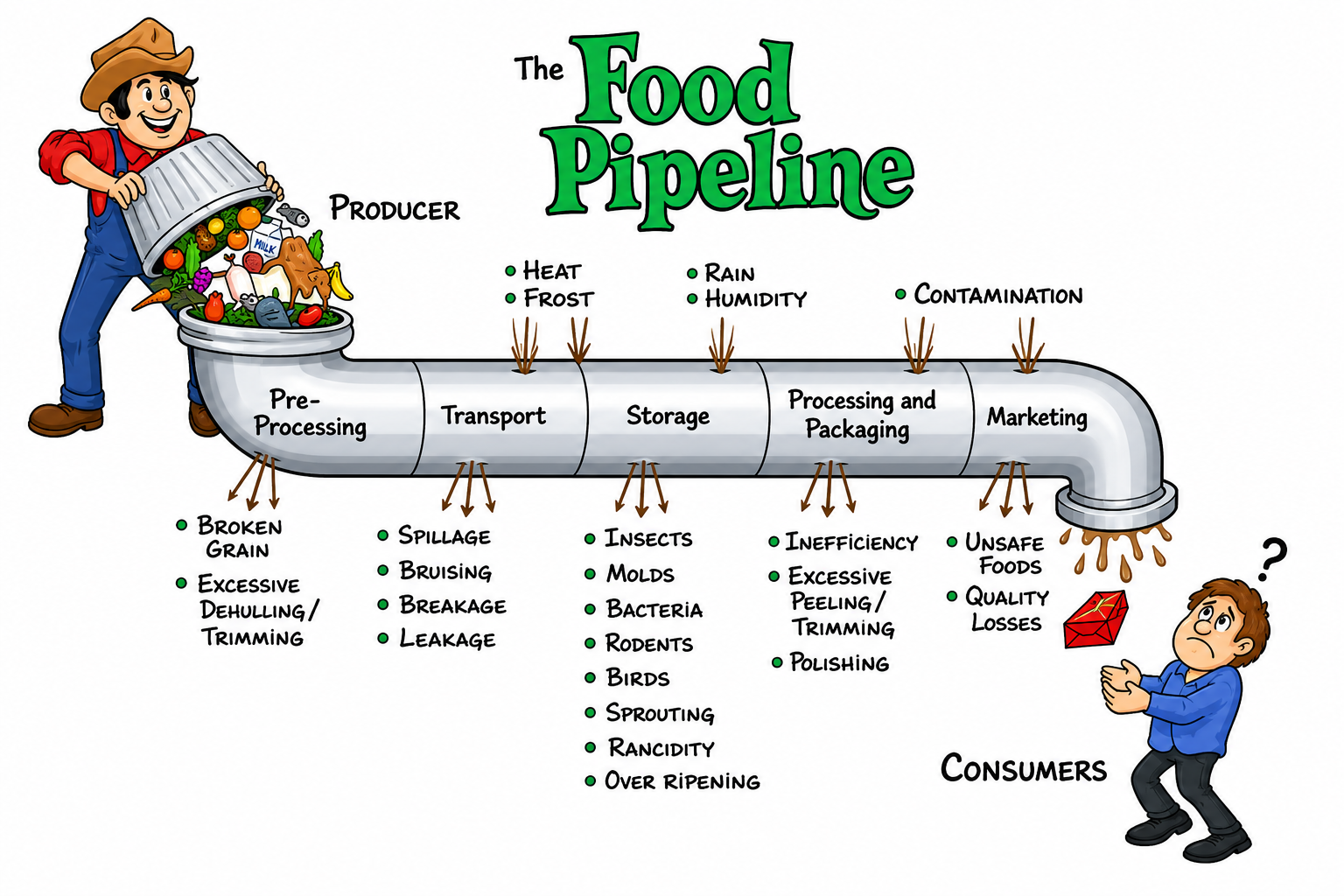
Indian agriculture had shown tremendous evolution since independence and converted India as exporting country from importer even after fourfold increase in population. Ever-increasing population however poses serious challenge to prolong this scenario and ways has to be thought of to provide safe and quality food to the masses. Increasing agricultural production is one aspect of fulfilling food demand. Delivering food to the consumers by saving produced commodities from losses in fields, transport, storage, retailing, processing etc. without straining our fields, water and environment seems much better option. After production, agricultural produce undergoes series of post-harvest unit operations, handling stages and storage before they reach to the consumers. Each operation and handling stage results into some losses. Two major government-commissioned studies have quantified post-harvest losses in India. The ICAR-CIPHET study (2015) and the NABCONS study (2022), both conducted under the Ministry of Food Processing Industries, provide the most comprehensive data. Food Processing Industries, provide the most comprehensive data. According to the NABCONS 2022 findings presented in the Lok Sabha, cereals suffer losses between 3.89% and 5.92%, pulses between 5.65% and 6.74%, and oilseeds between 2.87% and 7.51%. In absolute economic terms, India loses food worth approximately ₹1.53 lakh crore (around USD 18.5 billion) every year across all agricultural commodities, as reported by the ICRIER-ADMI study based on NABCONS data. These numbers are staggering, particularly when a large section of the population still faces food insecurity.
Causes of post-harvest losses
Post-harvest losses are not caused by a single factor. They result from a combination of biological, environmental, and systemic inefficiencies at every stage of the supply chain.There are various reasons like improper handling, damage by insects and pests, storage conditions, etc. that affect the agri-commodities adversely when they enter the post-harvesting phase.
Losses during harvesting and threshing
The supply chain begins at the farm, and losses start right at harvest. Harvesting at the wrong time – too early or too late – leads to significant problems. Early harvesting at high moisture content increases the cost of drying and makes grains susceptible to mould and breakage. Delayed harvesting results in shattering losses and exposes the crop to birds, rodents, and weather damage. A Punjab-based study found that delayed wheat harvesting increased losses from about 1.5% to 2.5%, roughly a 67% increase.
Losses during drying
Proper drying is critical because most grains need to reach a safe moisture level (below 13%) before storage. Sun drying – the most widely used method in rural India – is slow, weather-dependent, and exposes grains to contamination from dust, stones, and animal droppings. Grains laid out on roadsides or open grounds are vulnerable to birds, insects, and unseasonal rains. When grains go into storage without adequate drying, the resulting high moisture encourages rapid mould growth and mycotoxin contamination.
Inadequate storage facilities
Storage is the stage where the largest chunk of losses occurs in developing countries. In India, roughly 50-60% of harvested grains are stored in traditional structures – earthen pots, mud bins, bamboo baskets, gunny bags, and small rural godowns (warehouses). These structures are made from locally available materials, lack scientific design, and cannot protect grains from insects, rodents, or moisture fluctuations over long periods. Temperature swings between day and night cause moisture to migrate within the grain mass, creating pockets of dampness that become hotspots for fungal growth. Poorly maintained rural godowns often have leaking roofs, cracked walls, and inadequate ventilation, making them particularly prone to pest infestations. Among all biotic factors, insect pests are considered the most damaging during storage, causing 30-40% of storage losses in some cases. Storage pests such as the rice weevil (Sitophilus oryzae), the pulse beetle (Callosobruchus maculatus) and the larger grain borer (Prostephanus truncatus) feed on stored grains, reduce their weight, and contaminate them with excreta and body fragments. Rodents are another major problem in rural godowns, eating and contaminating stored grain.
Mycotoxin contamination
Fungi such as Aspergillus flavus and A.parasiticus produce aflatoxins, highly toxic compounds that make grains unfit for human consumption and pose serious health risks, including increased risk of liver cancer. Globally, an estimated 4.5 billion people in developing countries are exposed to aflatoxins through contaminated food. High moisture and warm temperatures in storage create ideal conditions for these fungi to thrive. Oilseeds are especially vulnerable because their high oil content can degrade rapidly in damp conditions, producing elevated fatty acid levels and sometimes even self-heating.
Transportation and handling losses
Moving grain from field to market adds another layer of loss. In many parts of rural India, grains are transported in bullock carts, open trolleys, or poorly maintained trucks over bad roads. Bags are loaded and unloaded multiple times – sometimes up to ten times before the grain reaches a mill. Each handling step leads to spillage. Low-quality jute and polypropylene bags tear easily, especially when heavy hooks are used for lifting. The result is a steady trickle of grain lost during transit.
Technologies and strategies to reduce post-harvest losses
Improved storage technologies
Scientific storage can reduce losses from double digits to under 2%. Some of the most promising options include:
Hermetic (airtight) storage: This method uses sealed bags or containers to create a low-oxygen, high-carbon-dioxide environment through natural respiration of the grain and any organisms present. This kills insects without the use of chemicals. Technologies such as PICS bags (Purdue Improved Crop Storage), SuperGrain bags by GrainPro, and metal silos have shown excellent results. In trials across Africa and Asia, properly sealed hermetic storage units reduced food losses by up to 98% compared to traditional storage.
Metal silos: Made from galvanised steel sheets, these cylindrical structures provide airtight, rodent-proof, and moisture-resistant storage. While the initial investment is higher, their durability and low maintenance make them cost-effective over time.
Modern warehousing: India’s government has launched ambitious initiatives to expand grain storage capacity. The World’s Largest Grain Storage Plan in the cooperative sector, launched in 2024, aims to add 70 million metric tonnes of storage capacity over five years, with an estimated investment of ₹1.25 lakh crore.
Improved processing technologies
For pulses, upgrading from traditional emery roller mills to modern cylinder-concave dehullers and CFTRI-type mini dal mills can dramatically improve dal recovery rates. Pre-milling treatments such as controlled soaking, oil application, and thermal conditioning help loosen the husk, reducing the need for aggressive abrasive dehusking and thereby cutting losses from broken and powdered grain.
For oilseeds, transitioning from simple mechanical expellers to double-pressing systems or combining pre-pressing with solvent extraction can recover a much larger proportion of the available oil. Even newer approaches like enzyme-assisted extraction and gas-assisted mechanical expression (GAME) are being researched to improve oil yields while reducing energy consumption.
Government Schemes
Government is proactively addressing the challenge of post-harvest losses through a comprehensive and integrated approach embedded within multiple flagship schemes aimed at strengthening the agricultural value chain. Key initiatives include:
i. Mission for Integrated Development of Horticulture (MIDH): Supports creation of infrastructure for post-harvest management including cold storages, ripening chambers, and pack houses to minimize wastages in fruits and vegetables.
ii. Agriculture Infrastructure Fund (AIF): Provides medium to long-term debt financing for investment in viable post-harvest management infrastructure including warehousing, cold chains, and primary processing units.
iii. Agricultural Marketing Infrastructure (AMI) Scheme: Supports creation of storage and marketing infrastructure to strengthen supply chains and reduce post-harvest losses at the market level.
iv. National Agriculture Market (e-NAM): Promotes better market access and price discovery, reducing transit losses through a more efficient supply chain.
v. In addition, Government actively promotes the formation & promotion of 10,000 Farmer Producer Organisations (FPOs) to facilitate aggregation, primary processing, and market linkages.
vi. In addition to above, Ministry of Food Processing Industries (MoFPI) has been implementing Central Sector Umbrella Scheme – Pradhan Mantri Kisan Sampada Yojana (PMKSY) since 2016-17 to create post-harvest infrastructure and processing facilities to boost overall development of the food processing sector including reduction in post-harvest losses, enhancing value addition etc.
Conclusion
Cutting post-harvest losses is one of the most resource-efficient strategies for improving food availability. India’s agricultural production story is strong, but production alone does not guarantee prosperity. Unless post-harvest inefficiencies are addressed, farmers will continue to lose value even after a successful harvest. Reducing losses by even 5–10% could save billions of rupees annually, improve farmer incomes, stabilise food prices, and strengthen national food security.
Author

Nishant Sidnal is a postgraduate student pursuing a Master’s degree in Genetics and Plant Breeding at Anand Agricultural University, Gujarat. Driven by curiosity and a passion for research, he enjoys exploring new concepts and translating theoretical knowledge into practical applications.