Walk into any thriving farm today and you will find a quiet revolution happening beneath the soil surface, invisible to thenaked eye but critical to every green leaf above it. Long before chemical fertilizers were ever manufactured, soilmicroorganisms were already feeding plants — fixing nitrogen from the air, unlocking phosphorus trapped in rock particles,and building intimate partnerships with roots. Modern agriculture is now rediscovering these ancient microbial allies andpackaging them as biofertilizers, offering farmers a way to grow more food while asking less of the soil, the water table, andthe atmosphere.
This renewed interest is not nostalgia; it is necessity. Decades of intensive chemical fertilizer use have left many soilsdepleted of organic matter, imbalanced in microbial diversity, and increasingly unresponsive to further doses of urea andphosphate. Biofertilizers offer a complementary, biology-driven path back to soil health without asking farmers to sacrificeproductivity.
What Exactly Is a Biofertilizer?
A biofertilizer is a formulation containing live or dormant cells of beneficial microorganisms — bacteria, fungi, or algae — that, when applied to seed, soil, or root, colonize the rhizosphere or the interior of the plant and promote growth. Unlike chemical fertilizers, which supply nutrients directly, biofertilizers work indirectly: they fix atmospheric nitrogen, solubilize locked-up phosphorus and potassium, produce plant growth hormones, suppress soil-borne pathogens, and improve the soil’s physical structure over time.
Because they multiply and act within the soil ecosystem rather than being consumed in a single season, their benefits tend to compound gradually, improving soil biology year after year rather than providing a one-time nutrient boost.
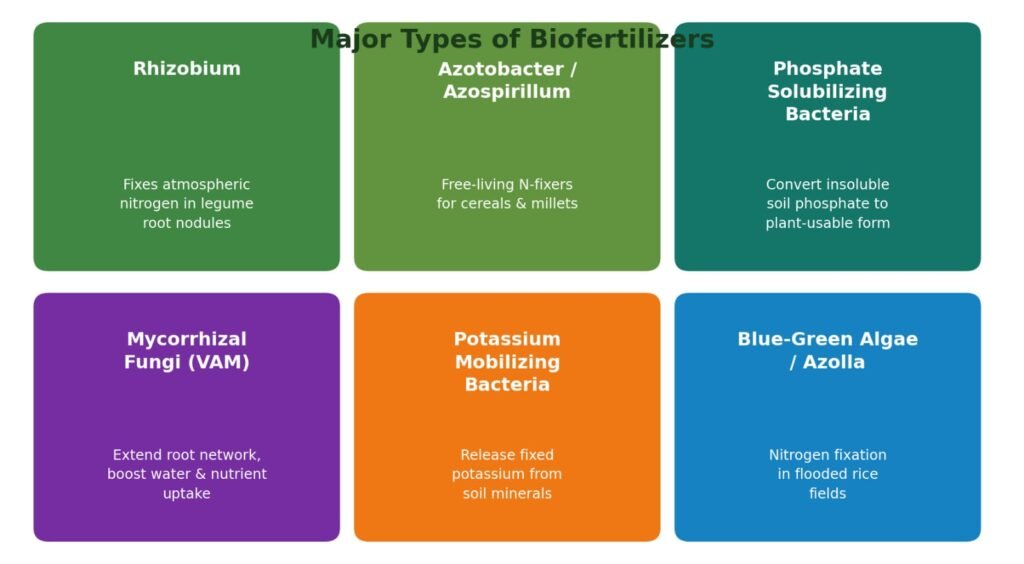
Fig. 2. The six major categories of biofertilizers used in Indian agriculture today.
The Microbial Toolbox
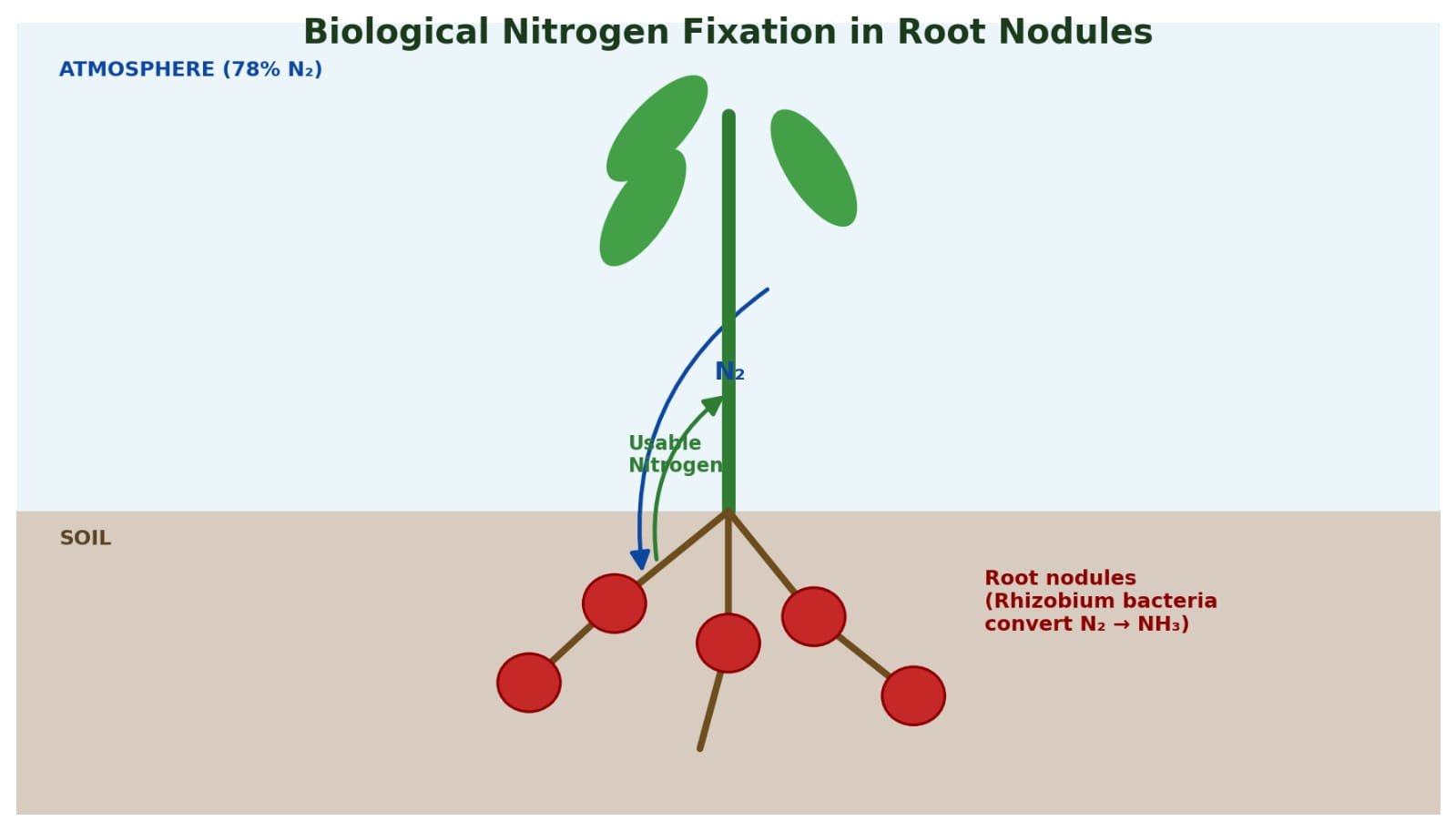
Rhizobium remains the best-known biofertilizer, forming a symbiosis with legume roots such as gram, groundnut, soybean, and pulses, where it fixes as much as 50–200 kg of nitrogen per hectare annually inside specialized root nodules. For non-leguminous cereals like rice, wheat, and maize, free-living nitrogen fixers such as Azotobacter and Azospirillum colonize the root zone and supply nitrogen while also secreting growth-promoting substances that encourage root branching.
Phosphorus is abundant in most Indian soils but largely unavailable to plants because it binds tightly with calcium, iron, or aluminium. Phosphate Solubilizing Bacteria (PSB) such as Bacillus and Pseudomonas species secrete organic acids that release this locked phosphorus, effectively unlocking a nutrient reserve that was already present in the field. Similarly, Potassium Mobilizing Bacteria (KMB) release potassium bound within feldspar and mica minerals, while arbuscular mycorrhizal fungi (VAM) extend a vast network of fine hyphae beyond the root’s natural reach, dramatically improving uptake of phosphorus, zinc, and water, particularly in dry and marginal soils.
In rice-growing regions, blue-green algae (Cyanobacteria) and the fern Azolla thrive in standing water and fix substantial nitrogen while also adding organic matter as they decompose, making them a traditional and still-relevant biofertilizer for paddy systems.
Why Farmers Are Turning to Biology
The appeal of biofertilizers rests on several converging benefits. They typically cost a fraction of an equivalent dose of chemical fertilizer, making them attractive to small and marginal farmers. They reduce dependence on energy-intensive synthetic nitrogen, whose production and overuse contribute to greenhouse gas emissions and groundwater nitrate pollution. Repeated application builds up beneficial microbial populations in the soil, gradually improving soil structure, water-holding capacity, and organic carbon content — improvements that chemical fertilizers alone cannot deliver.
Field trials across major crops consistently report yield gains of 10 to 25 percent when biofertilizers are used alongside a reduced dose of chemical fertilizer, compared with chemical fertilizer alone. The chart below illustrates the kind of yield improvement commonly documented in extension and research trials.
Where Microbiology Meets Plant Breeding
Biofertilizer research is no longer confined to microbiology laboratories alone. Plant breeders are now actively selecting crop varieties for traits that strengthen their partnership with beneficial microbes — denser root hair formation for better rhizobial colonization, enhanced root exudates that attract PSB and mycorrhizal fungi, and genotype-specific compatibility with particular Rhizobium strains. Breeding programs combining high-yielding genetics with strong microbial responsiveness are especially valuable for rainfed and nutrient-poor soils, where root architecture can decide whether a biofertilizer works well or barely helps.
This convergence of microbiology and genetics reflects a broader shift in agricultural science: crop improvement is increasingly viewed not as an isolated plant trait but as the outcome of a plant-microbe partnership, bred and managed together.
Using Biofertilizers Effectively
Biofertilizers are living products and demand a degree of care that chemical fertilizers do not. They should be stored in a cool, shaded place away from direct sunlight and used before their expiry date, since microbial viability declines over time. Seed treatment is the most common and efficient method of application: seeds are coated with a jaggery or gum-based slurry mixed with the biofertilizer culture, dried in shade, and sown within a few hours. Soil application and root-dip methods are used for transplanted crops such as rice and vegetable seedlings.
Importantly, biofertilizers work best as a complement to, not a replacement for, balanced nutrient management. Combining them with organic manures and a moderate, need-based dose of chemical fertilizer — an approach called Integrated Nutrient Management — consistently outperforms either approach used alone.
The Road Ahead
Challenges remain: shelf life, quality control, inconsistent field performance across soil types, and limited farmer awareness continue to slow wider adoption. Government schemes promoting organic and natural farming, along with rising consumer demand for chemical-free produce, are nonetheless pushing biofertilizers steadily from research stations into everyday farming practice.
As soils under chemical-intensive management show growing signs of fatigue, biofertilizers offer something chemical inputs alone cannot: a living, self-renewing partnership between plant and microbe that improves with time. For a country seeking food security without compromising soil for future generations, that may be exactly the kind of ally agriculture needs.
Authors