INTRODUCTION
Some products carry more than flavor, texture, or craftsmanship they carry the memory of a place. Darjeeling tea, Champagne, Roquefort cheese, Basmati rice, Kanjeevaram silk: say the name and an entire landscape, climate, and tradition unfolds in the mind. This is the quiet power of a Geographical Indication (GI)-a legal tag that ties a product’s identity permanently to its birthplace.
In an age of mass production and global supply chains, where a “Darjeeling tea” could theoretically be grown anywhere and still sold under that seductive name, GIs exist to draw a line. They say: this product is what it is only because of where it comes from.
What Exactly Is a Geographical Indication?
A Geographical Indication is a sign used on products that have a specific geographical origin and possess qualities, reputation, or characteristics essentially attributable to that origin. Unlike a trademark, which protects a brand owned by one company, a GI protects a name that belongs collectively to a community of producers within a defined region.
Think of it this way: nobody owns “Champagne” the way Coca-Cola owns its logo. Any grower or producer within the officially demarcated Champagne region of France, following the traditional method, can use that name. Someone producing identical sparkling wine in California cannot call it Champagne, no matter how good it tastes-that’s the entire point of the protection.
The World Trade Organization’s TRIPS Agreement (Trade Related Aspects of Intellectual Property Rights) formally recognized GIs as a category of intellectual property in 1995, giving countries a shared framework to protect such names internationally, even though individual nations still run their own registration systems.
Why Geography Actually Matters
Skeptics sometimes ask: does it really matter where cheese is made, or is this just marketing dressed up as science? The answer, more often than not, is that geography genuinely shapes the product.
Consider the science behind a few famous names. Darjeeling tea owes its muscatel flavor to the region’s high altitude, misty mornings, and specific soil composition in the Himalayan foothills-the same tea bushes grown elsewhere simply don’t taste the same. Roquefort cheese depends on natural caves in southern France where a particular strain of Penicillium mold thrives, giving the cheese its distinctive blue veins and sharp flavor. Basmati rice grown in the Indo-Gangetic plains develops its signature aroma and elongation upon cooking because of the specific alluvial soil and climate of that belt-attempts to grow “Basmati” seeds elsewhere produce a different rice entirely.
In each case, terroir-a French term originally used for wine, referring to the total natural environment including soil, climate, and topography-leaves an imprint that cannot be replicated by transplanting the same seeds or techniques to another location. GI protection simply puts a legal frame around what farmers and artisans have always known intuitively.
A Brief History of an Old Idea
The instinct to protect place-based products isn’t new. French winemakers began formalizing regional protections in the early 20th century, culminating in the Appellation d’Origine Contrôlée (AOC) system established in 1935, which regulated everything from Champagne to Roquefort. Other European nations followed with their own versions, and the European Union eventually harmonized these into the Protected Designation of Origin (PDO) and Protected Geographical Indication (PGI) frameworks.
What changed the game globally was the 1994 Uruguay Round of trade negotiations, which folded GI protection into the WTO’s TRIPS Agreement. Suddenly, a French cheesemaker’s local pride became an internationally enforceable trade right, at least in principle. Countries were now obligated to provide legal means to prevent misuse of geographical names, though enforcement across borders remains an ongoing struggle.
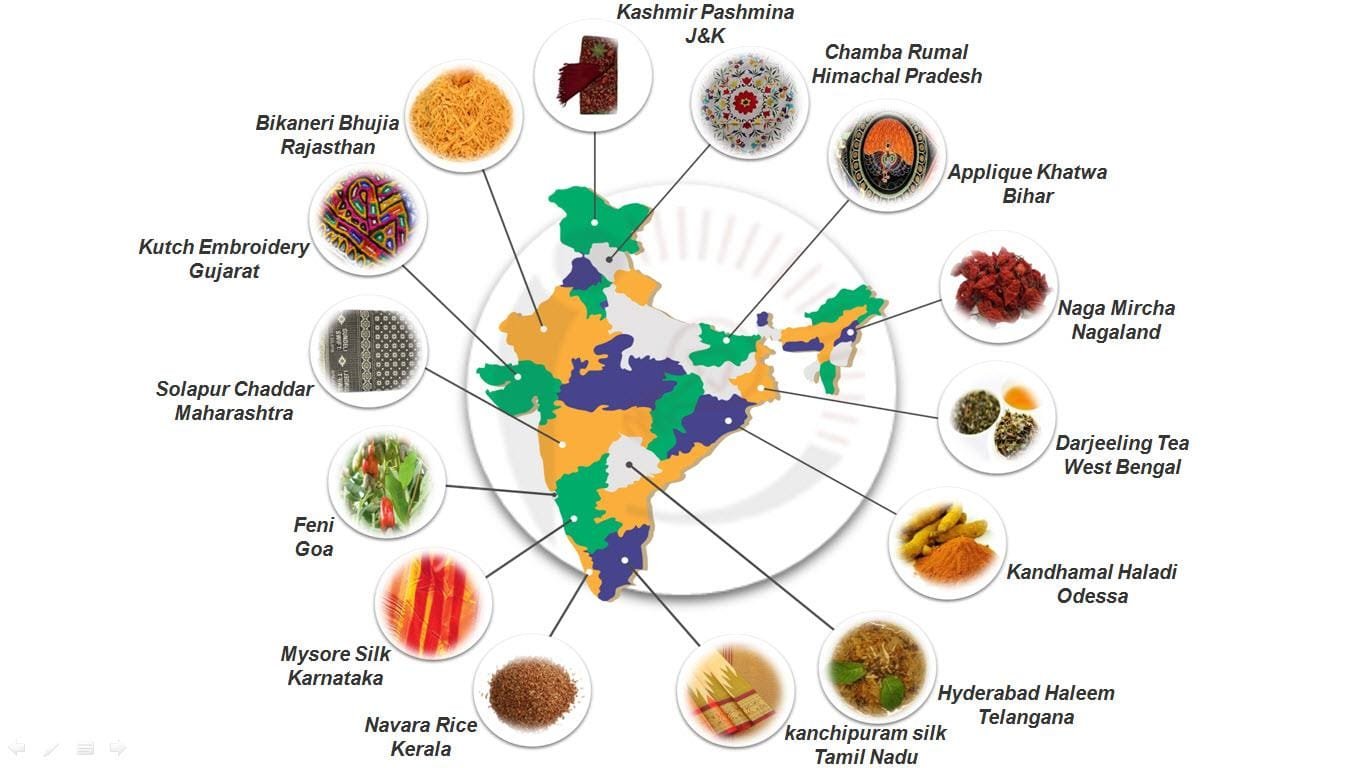
India entered this arena with the Geographical Indications of Goods (Registration and Protection) Act, 1999, which came into force in 2003. Since then, the country has registered several hundred products-from Darjeeling tea (India’s first registered GI, in 2004) to Nagpur oranges, Kancheepuram silk, Alphonso mangoes, and Kashmiri pashmina.
More Than a Label: The Economics of Origin
For producers, a GI tag is rarely just about pride-it’s about livelihood. Once a product carries legal protection, it typically commands a price premium in the market because buyers trust the authenticity behind the name. Farmers growing GI-tagged crops often see better returns than they would for generic equivalents, and the protection creates a barrier against cheap imitations flooding the market and eroding both price and reputation.
There’s also a ripple effect on rural economies. GI status frequently boosts tourism, as consumers travel to the source to experience the product where it’s made-wine tourism in Bordeaux or tea tourism in Darjeeling are prime examples. It can also encourage the preservation of traditional production methods that might otherwise be abandoned for faster, cheaper industrial alternatives, since the GI certification often requires adherence to specific, time-honored techniques.
For nations, GIs have become instruments of soft power and trade leverage. Countries negotiate mutual recognition of each other’s GIs in trade agreements, effectively using cultural heritage as an economic asset on the world stage.
The Challenges Nobody Talks About Enough
For all its promise, the GI system has real weaknesses. Registration and enforcement can be expensive and slow, and in many developing countries, the very artisans and farmers the system is meant to protect often lack awareness of how to apply for or defend their rights. A local group of weavers might discover their traditional craft has already been imitated commercially, using their village’s name, long before anyone thought to register it.
There is also the persistent problem of “genericization”-when a term becomes so widely used that it loses its specific geographic meaning. Names like “cheddar” or “feta” have, in various jurisdictions, slipped into common usage as generic descriptors for a type of product rather than a place, making legal protection far harder to reclaim once that shift has happened.
International enforcement remains uneven too. What is illegal to sell as “Parmesan” in the European Union might be perfectly legal to sell under that name in the United States, since the U.S. treats many such terms as generic rather than geographically restricted. These legal gaps mean GI protection often works well domestically but fractures at national borders.
Why It Matters to Ordinary Consumers
For everyday shoppers, the GI tag-often marked with a small logo or certification seal-functions as a shortcut for trust. It tells you the mango you’re buying really is an Alphonso from the Konkan coast, not a look-alike variety grown elsewhere and passed off under a prestigious name. In food, textiles, handicrafts, and even industrial products, this authenticity matters both ethically and practically: buyers get what they pay for, and the communities that developed these traditions over generations continue to benefit from their own heritage.
There’s a broader cultural dimension too. A GI tag is, in a sense, an official acknowledgment that a place and its people created something the rest of the world values enough to protect. It’s recognition wrapped inside a regulatory framework-proof that a specific hillside, riverbank, or workshop produced something the world couldn’t quite replicate anywhere else.
The Road Ahead
As global trade grows more interconnected and consumers grow more conscious of authenticity, sustainability, and origin, geographical indications are likely to expand well beyond their traditional strongholds of wine, cheese, and tea. Handicrafts, spices, textiles, and even non-food items with strong regional identities are increasingly seeking this protection.
The bigger question is whether the legal and institutional machinery-particularly in developing economies where much of this traditional knowledge resides-can keep pace with the ambition. Protecting a name on paper is one thing; ensuring that the farmers, weavers, and artisans who actually created that reputation see the benefits is another challenge entirely.
In the end, a Geographical Indication is less about legal technicality and more about a simple truth: place shapes product, and product shapes livelihood. Protecting that connection is, in many ways, protecting history itself-one bottle, one bolt of cloth, one handful of tea leaves at a time.
Authors



Akhil S is pursuing an M.Sc. in Agricultural Microbiology at Anand Agricultural University, Gujarat, after completing his graduation from Kerala Agricultural University. His academic interests include soil microbiology, plant–microbe interactions, and sustainable agriculture. He has authored popular science articles, contributed to book chapters, published research papers, and actively reviews manuscripts for scholarly journals. Passionate about research and scientific communication, he aims to contribute to sustainable agriculture through innovation, knowledge dissemination, and scientific excellence.