Agro-forestry is the cultivation and use of trees and shrubs with crops and livestock in the agricultural ecosystem. The core idea of agroforestry is to select the appropriate tree, planting it in an optimal location and ensuring it to serve the intended purpose. Agroforestry practices can be tailored to safeguard soil, animals, crops, and homes from extreme weather, enhance water quality, generate jobs and income and produce a variety of products (such as food, fibre, bioenergy, wood, floral, and medicinal goods).
Human civilization has altered planet’s climate system causing environmental shifts at an unprecedented rate. Agro-forestry is one potential climate change adaptation strategy to increase the resilience of farmers and agricultural systems against climate risk, providing a range of biophysical and socioeconomic benefits. This is a promising agroecological approach to climate change adaptation because of the multitude of co-benefits that many agroforestry systems provide in addition to climate change adaptation, including synergies with climate change mitigation through carbon sequestration, enhanced food security and income opportunities.
In view of the climate change scenarios, agroforestry systems offer a unique opportunity to address climate change adaptation and mitigation through the means of microclimate buffering and regulation of water flow. Intensification, diversification and buffering of trees in the farming system provide resilience to production under current climate variability as well as long-term climate change. This type of ecosystem has some advantages in production during drier and wetter years. Tree based systems have higherevapotranspiration rates than other productive systems; they maintain soil condition by pumping excess water out of the soil. It has the potential to prevent desertification and restore degraded soils. It enhances the micro-climate, soil fertility, nutrient cycling, biomass, carbon sequestration; it helps toreduce pressure from natural forests, which are the largest carbon sinks of terrestrial carbon. It can also help farmers reduce the economic recovery time of a natural disaster.
According to Nair (1987) agro-forestry can be classified into various systems listed below:
• Agri silvicultural system (crops with shrubs, vines and trees)
• Silvo pastoral system (trees with grazing land)
• Agro-silvo pastoral system (trees along with crops and grazing land)
Apart from these, trees can be paired with bees and fish facilitating honey and fish production respectively.
HOW AGRO-FORESTRY HELP COMBAT CLIMATIC CONSTRAINTS?
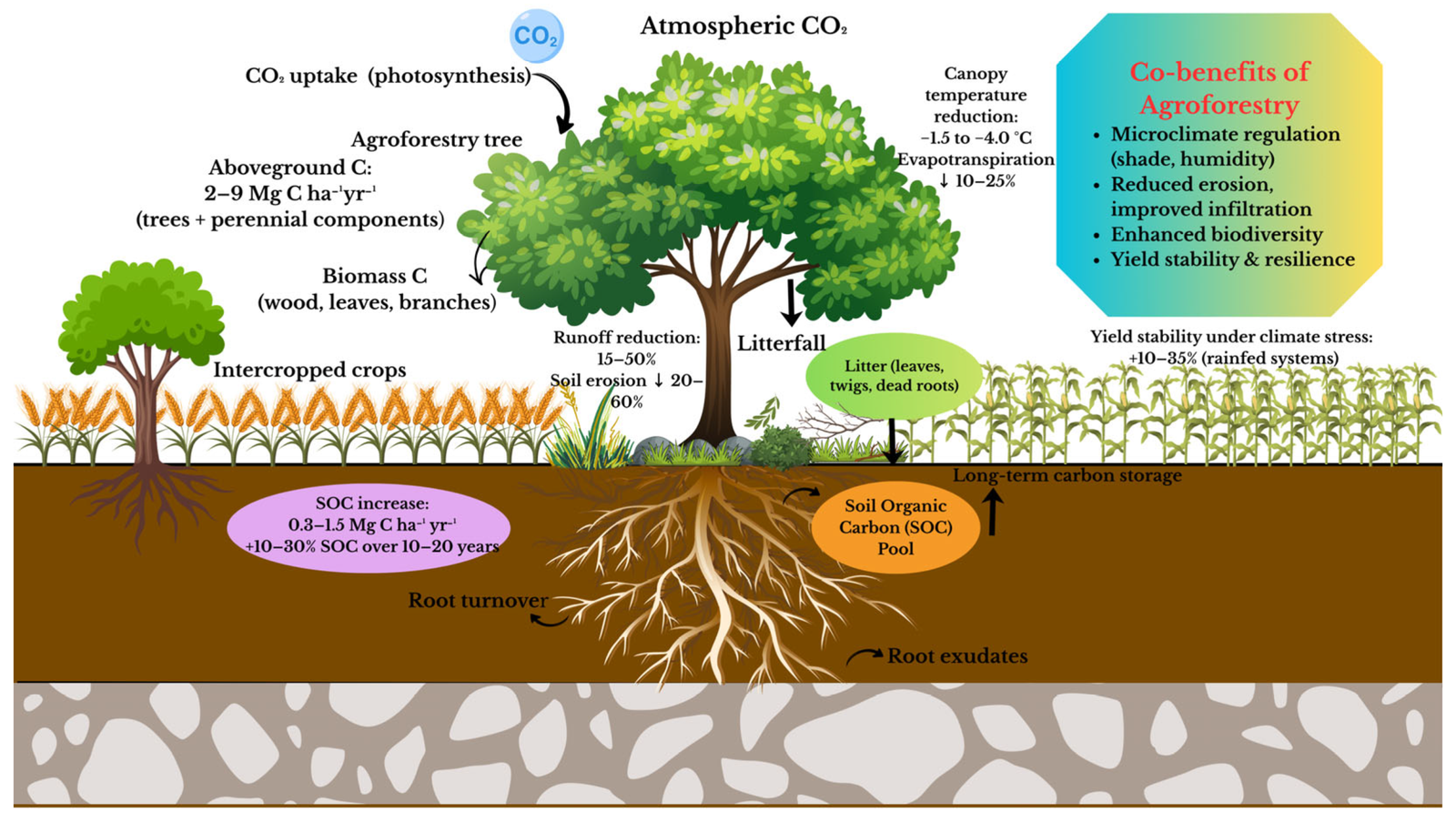
Agroforestry systems represent a powerful nexus of climate change mitigation and adaptation strategies, grounded in well-documented ecological principles. For mitigation, these systems act as significant carbon sinks by sequestering atmospheric CO2 into both above-ground woody biomass and, more substantially, below-ground as stable soil organic carbon (SOC). Beyond just biomass, the continuous input of organic matter makes soil a dominant carbon reservoir in thesesystems. Furthermore, agroforestry alters biogeochemical cycles to reduce emissions of potent greenhouse gases; for instance, the integration of nitrogen-fixing trees can decrease the reliance on synthetic fertilizers, thereby lowering nitrous oxide emissions, while improved soil aeration can enhance the soil’s capacity as a methane sink.
Concurrently, for adaptation, the multi-strata canopy structure modifies the microclimate by intercepting solar radiation, which can reduce understory temperatures by up to 4°C and significantly decrease evapotranspiration rates. These biophysical regulation conserves soil moisture and enhanceswater-use efficiency, building resilience against drought and thermal stress. The inherent biodiversity of these systems promotes greater productivity through mechanisms like niche partitioning and facilitation, allowing for more efficient use ofresources such as light, water, and nutrients. This heightened biodiversity not only supports critical ecosystem services likepollination and natural pest control but also diversifies agricultural outputs, thereby enhancing food security and providing economic stability against the backdrop of a changing climate. The increased ratio of GHGs in the atmosphere is increasing the global temperature. Agro-forestry seems to be a promising adaptation option for smallholder farmers to increase accessibility, production, livelihood and capturing atmospheric carbon as biomass.
BENEFITS OF AGRO-FORESTRY:
There are several important environment benefits of intercropping trees with crops on farmlands, both general and specific ecological benefits, which may include:
▪ Alleviation of forest pressure
▪ Enhanced nutrient recycling facilitated by deep-rooted trees
▪ Enhanced conservation of ecological systems
▪ Mitigation of surface runoff, nutrient leaching, and soil erosion through the obstructive influence of tree roots and stems
▪ Modification of microclimates by soil surface temperature reduction and diminished soil moisture evaporation via mulching and shading
▪ Augmentation of soil nutrients through the deposition and decomposition of leaf litter
▪ Enhancement of soil structure through continual organic matter addition from decomposed litter
Agroforestry systems on croplands offer substantial economic advantages to farmers, communities, regions, or nations.These benefits will encompass:
▪ Increased and sustained yields of food, fuelwood, fodder, fertilizer, and timber
▪ Decreased likelihood of total crop failure, which is common in single-cropping or monoculture systems
▪ Heightened levels of farm incomes owing to enhanced and consistent productivity
CONCLUSION
Integrated agro-forestry practices addresses a possible way to combat climatic changes that are disrupting our planet. However, we must note that there are some limitations in using this system such as competition between trees and crops for nutrients, trees also attract a variety of pests and fast-growing trees may overrun fields. Additionally, agroforestry is more intricate, less familiar, and harder to implement compared to single-crop farming.
By applying proficient management techniques, it becomes feasible to regulate any or all these factors. For instance:
a. Intercropping with legume trees with compactor sparse crowns to ensure adequate sunlight penetration for photosynthesis in the food crop.
b. Choosing deeply rooted tree species to facilitate the absorption of moisture and nutrients from the upper soil layer.
c. Increase the spacing between trees to mitigate their competitive impact on food crops.
Agro-forestry is being practised in different models in different countries worldwide, which helps to deal with the negative impacts of climate change which cany’ be dine by traditional agricultural practices.
Author

Nishant Sidnal is a postgraduate student pursuing a Master’s degree in Genetics and Plant Breeding at Anand Agricultural University, Gujarat. Driven by curiosity and a passion for research, he enjoys exploring new concepts and translating theoretical knowledge into practical applications.